Wednesday, May 23, 2012

Local Color: The Color is Green

Recently we drove up the 7乙, above Sanxia in the mountains of Taoyuan County.  We drove along the river to the very end of the road.  Hidden up there among the trees is a fish hatchery.  Welcome to the Taiwanese countryside.

The sign says, "Ecological Secret Hideout - Return Journey for the Fish."

This is to what the sign referred.


This temple was all alone out there.


A Western-style Farmhouse and Tea Field.


Other posts you may be interested in:


Traveling with M13:  Finding Toad Valley
Traveling with M13:  The Sequel:  Return to Toad Valley
Local Color:  The Colors of Yingge
Local Color:  The Temples of Taoyuan City

All Photos by Brenda and Emily Banducci

Thursday, May 17, 2012

The Taiwan Adventure on the Voice of Asia


Radio Taiwan International was started in 1928 by the government of the Republic of China to be the Central Broadcasting System (CBS) in Nanjing, Mainland China When the Japanese invaded in 1937, CBS moved to Hankou, then to Chongqing following the ROC government.  At the end of World War 2 the radio station went back Nanjing and four years later Radio Taiwan International moved to Taipei, Taiwan along with the ROC government.

Today RTI broadcasts in 13 languages to 122 countries, it is one of the oldest radio stations operating, broadcasting news and other programs. RTI provides opportunities for listeners around the world to become acquainted with Taiwan.  RTI is also called the Voice of Asia.

Natalie Tso
Recently, Natalie Tso, the host of Taiwan Today, interviewed me on the Taiwan Adventure Blog’s recent Taiwan’s Best Blog Award for 2011.   I appreciate Natalie for allowing me an opportunity to bore her listeners. 

Natalie is also from California, an American born Chinese, was educated at Columbia University and began her radio broadcasting career in 1993.  She is also a published author.  Her books include Free to be you:  A Woman’s Guide to Dreams, Love and Self Discovery and Free to Love.  She is also a contributor to TIME magazine. Writing articles on Taiwan.  

The following is the audio from our interview.  Thank you, Natalie for this opportunity.
Natalie Tso Photo:  http://english.rti.org.tw/hostinfo.aspx?tid=E9F45554960FB097


Tuesday, May 8, 2012

Day Tripping: Jiufen


The view from Jiufen

Now that the weather has turned nice again, we are back on our schedule of Monday day trips.  Yesterday, we drove about an hour northeast of Taoyuan to a place called Jiufen 九份.  Jiufen is a historic mining town built in the mountains overlooking the northeastern coast of Taiwan.

If you’re driving from Taoyuan City, take National Highway 1 through Taipei, exit at the Badu interchange to Highway 62.  Follow Highway 62 to the Coastal Highway (Prov. Highway 2D) then exit to Highway 102.  Follow that into the mountains and you will find Jiufen. 

There are a number of things worth seeing there.  Jiufen has a beautiful view of the Northeastern Coast:  Beautiful bays, huge rocks and the Pacific Ocean.  There are a number of tea shops that overlook the the ocean and you can sit and drink tea and enjoy the view.  But the biggest attraction is the Jiufen Old Street area.

The entrance to Jiufen Old Streets
It’s similar to many of Taiwan’s historic "Old Street" areas.  But Jiufen is built right into the side of the hill.  Tourists from all over the world come to Jiufen when visiting Taiwan.  My daughter and I sat in one spot for a while and guessed where people were from.  We saw Norwegians, Germans, Americans and many people from Mainland China.  If you’re a homesick foreigner, like my children, this is a good place to come to find your countrymen.

If you visit Yingge, the old street area centers around ceramics.  There there are a lot of stores that’s sell only ceramics, but Jiufen is different, here the vendors are much more eclectic.  We saw a number of shoe shops, food vendors, teashops, traditional clothing stores, and of course souveneir shops.  (What tourist spot doesn’t sell souvenirs to tourists?) Just about everything was for sale here.

Grilled Sea Snails
I, of course was interested in food.  I’m always interested in food.  We found a number of vendors selling the local snacks.  Things like Squid on a Stick, some kind of sea snail, and sausages.  I will eat just about anything, but for the less adventurous, they had other Taiwanese snacks that were a little more common.

We took the wheelchair and found it pretty tough going.  The area is steep and paved with old rough-hewn stones.  We parked at the top of the area near the park and had to go down the hill, which was a bit scary.  If the wheelchair got away it would have been disastrous.  Going up the hill on the way back was very difficult for the one pushing.  So if you’re disabled it may take a bit of planning.  But it was a fun and interesting trip.  We have already discussed a return trip when family comes to visit in the fall. 

Temple rooftops in Jiufen.

Jiufen is built right into the side of the mountain.

Squid on a Stick

Lots of tourists visit Jiufen


Tombs built into the Hillside


Other posts you may be interested in:

Tuesday, May 1, 2012

Living in Taiwan: The Wheelchair Scooter


Places that I go that require walking long distances or dealing with large crowds are difficult for me.  I get tired quickly and after about an hour I’m completely exhausted.  Crowds present a different problem because of all the jostling and quick stops I have a tendency to lose balance and fall.  It is no fun laying on the ground in a large crowd.  People fall over you or trample you.  It can be a bit intimidating.  So in those types of situations I use a wheelchair.  The problem with wheel chairs in my situation, is that because of the Muscular Dystrophy and muscle wasting that comes with that, it’s difficult for me to maneuver or move the chair on some surfaces.  I do okay on tile floors or cement sidewalks but carpet and asphalt are more difficult.  So I have to depend on the love and care of a relative or friend to move me along.

We have all seen those little electric mobility scooters.  They either have three or four wheels and they travel really slowly.  These have been great thing for disabled people providing them mobility and access to places they might not otherwise be able to go.  The problem with them for me is that they are primarily designed for short trips.  I can’t drive a mobility scooter 12 kilometers to Daxi.  They’re wonderful for a short trip through the neighborhood, but not for long rides.

When I moved to Taiwan, I discovered an excellent solution to the mobility problem.  It travels at roadway speeds.  It gives you all the fun and freedom of a regular scooter and allows you complete independence:  The Wheelchair Scooter.  This is a scooter that is designed to accommodate a wheelchair. 

The wheelchair scooter is another modification of a standard scooter.  I have a modified scooter, with extra wheels to give me stability to get on and off, but this is a modification that allows you to drive your scooter while remaining in your wheelchair. 

Any company that customizes scooters can help you to modify your scooter to accommodate a wheelchair.  Actually the scooter dealer can make all of the arrangements and include the modifications in the sale price. 

A regular scooter is cut in half.  The front wheel and handlebars are placed in front of a box, with a hinged ramp like door.  The rear of the bike is then attached to the side of the box.  On the other side of the box is another wheel.  The result is a type of trike, with the engine and drive wheel on one side along with a passenger seat.  The driver sits in his wheelchair safely locked into the box and steer and operates the scooter with his hands.  The scooters, as with all scooters are completely hand operated.

The scooter will travel at road speeds, is stable and easy to drive.  The only difficulty is parking.  It is much too large for a regular scooter parking spot and too small to use a car spot.  However, it has been my experience that the police are tolerant of disability scooters parking in places where they wouldn’t allow a regular scooter to park. 

There's room for a passenger on the seat.
I once parked in a place where a number of scooters were parked only to come back and find all the scooters but mine were towed a way.  I think there are two reasons for this one personal and one economic.  Police like everyone have compassion and realize that people with disabilities may need to park closer to the building than others.  The economic reason is that my disability scooter takes up two places in the towing vehicle.  That’s one less impound charge for the towing company. 

The following video is by Mordeth 13:


Other posts you may be interested in:

Photo credits:  http://www.mobilityzone.co.uk/acatalog/Shoprider_Cordoba_Mobility_Scooter.html
Wheel Chair Scooter: (screen capture)  Mordeth 13 (M13)
Thanks to M13 for the use of his video, Wheelchair Scooters 
All other photos Chris Banducci

Wednesday, March 28, 2012

Living in Taiwan: Coping with Disability


Somehow, over the years I’ve become sort of ancient.  I don’t know when it happened but in fact, my once boyish good looks have been obscured by the gray hair, wrinkles and bifocals.  I’m sure they’re still there someplace, but they haven’t been seen in quite a while. 

I remember stuff like party lines, cars that were actually made of metal, The Beatles first visit to the Ed Sullivan Show, (just knowing who Ed Sullivan is marks you as ancient), Herman’s Hermits, Batman on TV, (Holy Old Guy, Batman).  I remember when transistor radios first became available.  I remember pre-color TV.  Gadzooks, I even remember saying Gadzooks. 

What I don’t remember is why I walked into a room.  I forget what I’m looking for.  I blank out on people’s names; I lose a thought in the middle of a sentence.

There is one other way that I can tell that I’ve reached my dotage.  Everything hurts a little more than it used to.  I used to laugh when Curly on the Three Stooges would say, “Oh my aching sacroiliac.”  I didn’t know what a sacroiliac was; now mine is aching.

But aging isn’t really the issue here.  It only exacerbates the real issue.  Because I’m aging the problems that I have are just a little harder to deal with.  I have Limb-Girdle Muscular Dystrophy.  The disease began to make it’s presence felt twenty-six years ago, but in the last ten or so years, life has become more of a challenge.  There has been a gradual weakening of the muscles in my thighs and arms for all of that time.  I find that as I age my stamina and physical abilities have decreased.  My ability to tolerate pain has also decreased.  So age and disability has combined to make my life a challenge.

The question is, “What do you do about it?”  I think there are a number of approaches one can take.  The first is to just give up.  It’s hard and it’s painful, and it isn’t going to go away, so why bother.  The second approach is to curtail your activities, and only do what is easy.  The third is to continue with life, doing what you’re doing, and keep doing it until you no longer can.

The third approach has always been my philosophy.  I just keep doing what I’m doing looking for ways to adapt to the changes taking place in my life, continuing to press on.  I made a decision a few years ago, to move to Taiwan and continue on in life, rather than stay comfortable in the place I was.  I don’t regret that decision.  But moving to Taiwan has led to some obstacles that I need to address in order to live here.

In the US there is a law called, The Americans with Disabilities Act.  The law requires handicap accessible features to be built into every business and public facility in America.  I recently read that the Justice Department is working on making all public swimming pools wheelchair accessible.  The act is wide ranging and designed to protect disabled people from workplace discrimination and other things, but what I want to focus on here is accessibility.

The law requires accessibility.  There are requirements for wheelchair ramps, access to sidewalks, sidewalk width and specially designed parking spaces for wheelchair accessible vehicles within a specified distance from the door to a business or government office.  Because of this law many disabled people are better able to function independently within society. 

Taiwan makes some provisions for disabled people.  You are able to get a Disability placard and book that describes your rights as a disabled person.  There are some provisions made for discounts in vehicle registration costs.  The placards that can be used to have access to special parking in places where these parking spaces exist.  But the laws are not nearly as comprehensive in terms of access as in the US.  I’m not saying this as criticism; there are reasons why US style access would be difficult to implement here.

So what kind of difficulties exist for disabled people?  One difficulty is parking.  Everything is built close together.  Everything is built up rather than out.  There is no requirement for off-street parking.  The reason for this simply is:  Taiwanese cities are crowded and there often isn’t any room for off-street parking.  Cars have to park anywhere they can.  If you have difficulty walking, a two-block hike may be a problem.  There is little, if any, special parking for wheelchair vehicles that provides room for safely getting into or out of your wheelchair without being in the traffic lane.  Once you do get to the business there may be stairs that you must get past to enter the building.  Often the steps have no handrail, so for a person who walks and climbs with difficulty this is another problem. 

Look at the wide clear sidewalk, this is unusual for Taiwan
Many times sidewalks are uneven.  The front of one building may be lower or higher that the one next to it.  Non-disabled people are often tripped up by the unevenness of the sidewalks.  This is even more of a hazard for unsteady walkers and may be a real difficulty for wheelchairs.  Finally, there are barricades that have been set up to keep scooters from in front of a business; they also keep wheelchairs from passing as well.

When I go to a place I have to plan how I will get up the curb, often very high curbs, up any steps and into the business.  I have to think about parking.  In some instances there is just no way I can access a business, so I have to find an alternate place.  It may be farther away and present it’s own access problems.

There are ways to mitigate many of the problems.  I bought a handicapped scooter.  It’s a scooter with two extra wheels on the side for stability. This easily mitigates parking and walking problems, because I can usually pull right up to the door of the business. Steps are much more difficult.  What I have found, though, is that if you can make yourself known to the business owner or employee they will happily help you climb the steps, get the merchandise for you or handle the transaction right where you are.
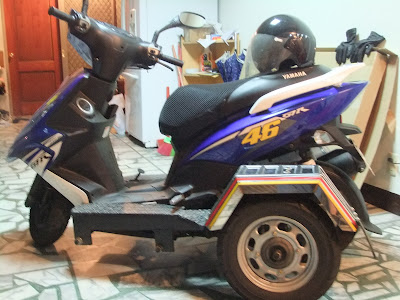
A scooter designed for disabled people.
The two approaches to accessibility are interesting.  The US approach is to legislate that businesses and public facilities build in access at their own expense.  The Taiwanese approach has to do with business owners and public facilities providing human assistance.  

The legislative approach has advantages because accessibility is guaranteed under the law. 

The human approach also has advantages, one of them being, interaction and compassion between individuals.  I always look for relationship over legislation. 

Disabilities are always a challenge.  I think it is a part of the human spirit to meet and overcome challenges.  What’s powerful, in my mind, is that people will reach out and provide help and concern for each other without being legislated into it.  This is what makes Taiwan such a wonder for me.  Most people are willing to be help and care for their neighbors, coworkers and often strangers without government intervention. 

I want to close with two brief stories.  One takes place in Southern California and one in Taiwan: 

In Southern California, I visited a Walmart on a very hot day.  I got out of my truck and started walking toward the store, and fell in the middle of the parking lot.  The temperature was 108 F (42 C).  Because I wasn’t able to stand up, I had to crawl back to my car in order to get up.  Even though there were a number of people in the lot no one was able to help.  I ended up with burns on my palms and tears in my blue jeans.

In Taiwan, I walked out of building and tripped over a small ledge and fell.  Before I could even start to stand up I was surrounded by people who reached down and helped me get to my feet.  Two men actually reached under my arms and lifted me to my feet. 

I’m not saying that people in Southern California are bad or evil, and that Taiwanese people are better.  But I think it points something out.  In a place where everything is legislated, and laws are put in place and people are afraid of breaking some law or being sued, people are less willing to intervene in another person’s suffering.  That’s why I say I would rather have relationship over legislation.


Friday, March 9, 2012

Special Guest Post: Flat Stanley Comes to Visit


Going on the motorcycle.  Look!  I'm wearing a helmet.
Editor’s Note:  This week I received a visit from Flat Stanley.  Flat Stanley is a character from a Children’s book.  I’ve received visits from Flat Stanley occasionally, since I’ve been here.  This time he came from a second grade class in El Cajon, CA.  I’ve asked Flat Stanley to write down his thoughts as a guest post.

Hello from Taiwan!!  This is your old friend Flat Stanley.  As soon as I came out of my envelope I met a friend and he took me to see Taoyuan City.  Taoyuan City is a city with 380,000 people in Northern Taiwan, near the capital, Taipei.

The first adventure we took was a ride on Chris’ motorcycle.  He rides a scooter.  Lots of people ride scooters in Taoyuan City and I had a lot of fun buzzing through town on the scooter. 

A Temple in Taoyuan City.
On our ride we saw a lot of things.  The first was a Taoist Temple.  These are the types of buildings you think of when you think of China.  Taiwan is a religious country.  Most of the people believe in Taoism or Buddhism.  There are only a few Christians in Taiwan.  People come to the temples to offer incense and food to their gods.   They even burn a special kind of money, this money is supposed to go to their dead ancestors so they can buy what they need, while they wait to be reincarnated.  When they worship they play music and light firecrackers.  It’s very different. 

This place is to honor people who died in the war!
The next place we saw was called the “Revolutionary Martyr’s Shrine.”  In 1911, China fought a war called the Xin Hai Revolution.  This war was a war of independence, like the USA’s.  The people wanted to govern themselves.  In that war many people died, this is a building to honor those people who died.  Every hour they have a ceremony to change the guard.  The soldiers march in precision and toss their rifles back and forth.  It is done to honor those soldiers who died.

After that, we went to the Taipei 101; it is the second tallest building in the world.  This building is 101 stories tall.  You can go up to the 89th floor in the fastest elevator in the world.  It takes 38 seconds to go all the way to the 89th floor.  I’m glad Chris had put me in his pocket or I might have just flown up to the top when the elevator stopped.  What a cool ride.

The Taipei 101:  It's pretty tall!
After the 101 we went to a night market.  These are very popular in Taiwan.  It’s kind of like a swap meet where people sell lots of things and a lot of different types of foods.  I ate a food called “Shui Zhen Bao” (shuay jen bow).  This is some seasoned pork wrapped in bread that’s fried in water.  It was delicious.  There’s another food that’s very popular called Stinky Tofu, but I was afraid to try it.  It’s really stinky, but Chris has tasted and he says it’s delicious.

They have a holiday here called the lantern Festival, and it’s really cool they make lanterns and write things on them, then they release them and they fly above the city.  I got here a week too late for the lantern festival, but I saw some lanterns that were made.

Taiwan is known for growing rice and tea.  There are rice fields everywhere.  People even have rice growing in their front yards.  This is only in the country areas, because in the cities people don’t have any yard.  But all the vacant lots grow rice and it is neat to see the fields. 

This man is fertilizing the Rice!
I was getting really tired so we decided to go home.  Houses in Taiwan are different from houses in America.  A house in Taiwan is usually three or four stories tall.  Many of them have a balcony on the roof, so people can grow plants and have a place to sit in the evening.  They don’t have yards.  These types of houses are called tou tians (Tow Tians).  But most city people live in apartments.  Many Apartments are 20 stories tall. 

Taiwan has a lot of American restaurants.  Kentucky Fried Chicken, McDonald’s and TGI Fridays all have restaurants in Taoyuan City.  Guess what, in Taiwan, McDonald’s will deliver the food right to your house.  Wow, you don’t even have to leave home to eat McDonald’s. 
Here I am eating Shui Zhen Bao.  If I eat too many I'll be Fat Stanley!
This is Stinky Tofu.  Boy is it Stinky!


This is a lantern from the Lantern Festival!


I made some videos for you to see what Taiwan is like:


I hope you enjoyed my visit to Taiwan.
Now I have to go back in my envelope so I can come back to you.  Oh well, at least I always travel first class!

Thursday, February 9, 2012

Taiwanese Traditions: The Lantern Festival


Lanterns from last years Lantern Festival

For the second year in a row, my wife and I have tried to make it to the Lantern Festival in our community.  Last year, it was on Sunday, which make it impossible for us to go, but this year it was on Monday.  The weather was beautiful that day, too.  Monday is the day we usually plan to go somewhere and do something.  We went, but we couldn't find it.

It was interesting because we went on the Taoyuan County website, and they talked about it being on Nankan Creek, but it wasn’t too specific about what part of the creek.  I would have thought that someone could have put a Google map on there to show where to go, but they didn’t.  I’m making myself a promise right here; right now, that next year I will make it to the festival.  To me, it’s the most interesting of all the festivals, which happen in Taiwan.  There is one other celebration that holds an interest for me, the Yan Shui Fireworks festival where they fire fireworks right at you.  You see people wearing heavy clothing and their motorcycle helmets while the fireworks smash against them.  That would be fun to see but I’m not sure about participating.  I’m old and slow and I think I’d be a sitting duck.

Lantern from the Year of the Rabbit
The Lantern Festival usually lasts about a month or couple of weeks, this year in Taoyuan County the festival lasted from January 28 through February 6, and is sometimes called, “little New Year.”  The Lunar New Year is, of course, the Big New Year.

There are a number of legends associated with the origin of this festival.  Many of the legends are associated with relationships between people and their gods. I found one of them to be very interesting:

The first is a legend that tells of a beautiful crane that flew from heaven to earthy.  When the crane landed on earth the people of a certain village killed it.  The Jade Emperor (The Emperor of Heaven) was angry and sent an army to destroy the people and the village.  Apparently the crane was the Jade Emperor’s favorite bird, so his plan was to destroy the village through a storm of fire on the fifteenth day of the first month according to the lunar calendar.

The Jade Emperor’s daughter warned the village of their impending disaster so that they could prepare.  The village people were frantic because thy had no idea how to turn away the wrath of the Jade Emperor until one wise man came up with an idea.  He said to hang lanterns and light bonfires throughout the city, so that when the soldiers arrived, they would think the village was already ablaze and leave without further damage.  The villagers embarked on that particular plan and the village was saved.

The interesting thing to me is the similarity to the legend surrounding the origin of the Chinese New Year traditions.  See Taiwanese Traditions:  Chinese New Year:  The Legend of Nian.

There are a number of ways that the lantern festival is celebrated in modern Taiwan.  This year, the Taoyuan Lantern Festival was an aquatic festival, where lanterns were lit and floated in Nankan Creek.  In Pingxi, the lanterns were lit and released into the sky. And In Yanshui, fireworks were lit and flew through the crowd.  In each, there are lanterns that are made.  Many are complex works of art that depict people and animals, as well as the sky lanterns on which are written wishes for the new year.  These are lit and released into the sky.  There are also lanterns on which riddles are written and children sped time to solve the riddles. 

The Beautiful Crane of the legend
It is a fun time where families and friends get together and enjoy each other.  There is also a romantic feeling as young couples stroll together and spend time together.  In the early days this was the time when young people strolled the streets with their chaperones in the hopes of finding a spouse.  Matchmakers were busy in the weeks prior to the Lantern Festival trying to find the best matches for the young people.  As marriages in Taiwan are no longer arranged this part of the festival has disappeared.  Now young people enjoy the festival with their lovers.