Monday, June 27, 2011

Rolling East: Traveling in a Wheelchair

International Symbol for Disabled Person


This is a bit of a departure from my usual posts because it doesn’t speak directly about some aspect of life in Taiwan. I recently traveled to the US for an opportunity to attend a conference and catch up with some friends and relatives. Most of my traveling is done in a wheelchair. Oh, I can walk, but airports present a bit of a problem for disabled people. There are often long distances that must be covered, long lines (like at customs), or movements between gates, especially between domestic and international gates that must be traversed in ridiculously short periods of time. I can walk, but I’m afraid it looks a lot more like the “Zombie Shuffle” than walking, and running is completely out of the question.
Fortunately, most airlines provide wheelchair service to disabled passengers. They coordinate with the airports to transfer you between gates and airlines, to the luggage carousel, through customs and immigration, even out to the curb to the taxi stand. Wheelchair passengers are the first ones boarded and the last ones off. One real benefit is that the “Wheelchair Operators” are knowledgeable about the airport; transfer procedures and security processes and can just take you through the process without any hassle.

There is one drawback to wheelchair travel…security. Wheelchairs, for obvious reasons, can’t pass through metal detectors. For me to get out of the chair and try to walk through is a extremely difficult, so in every instance I was required to endure the dreaded TSA Pat Down Procedure.

I’m fairly pragmatic, I don’t like the intrusion into my personal space, I don’t like the erosion of my rights, but I really hate missing my flights, so I’m willing to endure it, if it will keep old women and babies with bombs off of planes. I’m not so sure about the effectiveness of this system, though, because we are so careful to avoid profiling and looking like we’re picking on people, that I’m afraid the ones who are the real threats are just getting on planes, flying around, and laughing at us.


Part of the Dreaded TSA Pat Down
 The TSA agents that I encountered were professional, polite and thorough. They explained the entire process, asked me if I wanted a private screening and then told me exactly what they were going to do just before they did it. Actually, I was impressed, with the care with which they violated me. I even had the thought that they probably didn’t want to do the pat down anymore that I wanted them to do it. As with anything professionalism varies from person to person. Maybe I was lucky and encountered only agents with a high degree of professionalism, in any case, it wasn’t as bad as I thought it would be.

I have to tell you after watching the videos and reading the reports I expected it to be horribly humiliating and dehumanizing but, really, it wasn’t. What was horribly humiliating and dehumanizing was high school PE class: Guys standing around snapping guys with towels and yukking it up about each other’s shortcomings, THAT was humiliating and dehumanizing. But throughout the entire pat down process, in three airports, I didn’t even see one rolled up towel and there were no snickers or nicknames.

I still think the whole thing is an intrusion on people’s rights and privacy. I still think the policy needs to be changed to be more realistic, but for the guys on the line who do the pat downs, when it’s handled professionally like it was with me, I appreciate their willingness to endure a lot more pat downs than I will have to endure. I travel occasionally; they have to do that every day.

But it didn’t stop at the US, when arriving in China, on the way to Taiwan; I had to go through the exact same process I did in the US. The only difference was that a young woman gave this old man the TSA Pat Down. My emotions in that situation were somewhat different.

In all other ways traveling in a wheelchair is a comfortable and less stressful way for disabled people to travel.

Other posts you may be interested in:


Cultural Unawareness:  The Wheels of Bureaucracy Turn Slowly
Random Asianess:  The Rest Stop

Photo Credit:  Pat Down procedure:  www.butyoudontlooksick.com

Wednesday, June 8, 2011

Random Asianess: Eating Snake

Enjoying the Night Market Atmosphere
Last time I wrote about our trip to Huaxi Night Market in Taipei. This week I wanted to write about the “Snake Alley” Restaurants. In the past there had been a number of them but as of this last month there are only two snake restaurants still serving snake in at Huaxi Night Market.

Recently, two friends and I went to “Snake Alley” to try out this food. Things have changed there quite a bit. The restaurants no longer do “snake shows.” The snake shows showed a number of things. They would feed the snakes mice and rats. They would handle the snakes and finally, they skinned the snakes, alive. As I’ve said these are no longer done. There have been a number of complaints to the government by animal rights activists on behalf of the snakes. The government no longer allows the snakes to be mistreated.

Those restaurants no longer allow you to photograph the snakes or the people. In fact, at one of the two restaurants the owner was so hostile toward foreigners and photography that he didn’t want us to come to his restaurant. We were greeted with a refusal to speak to us and some pretty severe looks. The other restaurant welcomed us but still insisted that we take no photos of the snakes or the rats.

We tried three types of snake meals. We ordered snake soup. Snake soup is served with a cup of blood. They also gave us cups of snake venom, snake wine, snake oil and snake reproductive parts. The snake sellers believe that snake has many medicinal purposes. The man told us that snake oil is good for your throat and sinuses, joints, overall vitality and just about everything else. In the US they used to call people selling cure-alls “Snake Oil Salesmen,” one can only assume that this is why.

Snake is also considered to be an aphrodisiac. The problem with this is that the fried snake that I had was cooked with so much garlic that I smelled like garlic for a couple of days. This is not exactly romantic. So the question for the ages is this: Can the aphrodisiac properties of snake over come the turn-off properties of smelling like garlic for multiple days.

Snake Soup

The snake soup was a thin broth containing two small pieces of snake. It was served with the blood, venom, oil, snake wine, reproductive parts and two small capsules of medicinal snake oil. As a meal goes it wasn’t much.

Fried Snake

I wanted to try something different. I was interested in the snake meat. I wanted to know what it tasted like. You know the old saw, “It tastes like Chicken.” Well, that’s sort of accurate. It is a lightly flavored meat, with roughly the consistency of chicken. It was actually a bit tougher. The snake was served with some green vegetable and a spicy (And extremely garlicky) sauce. I enjoyed the taste; in fact, I thought it was very good.

Snake Skin

We also tried snakeskin. It was served in a sauce similar to the sauce used for the fried snake. But the difference was that it was very chewy. It reminded me a great deal of the taste and consistency of squid. It was also heavily garlicked.

A Very Young Ma Ying Jiu (right) and His Cook
There was one other interesting thing about this particular restaurant. In it they have a picture of a very young Ma Ying Jiu (Taiwan’s president) with his arm around a guy in an apron. We asked the owner what the story was behind the photo and he told us that the man was a cook who had gone on from cooking in this restaurant, to be Ma Ying Jiu’s private cook. I can only assume that President Jiu is a huge fan of garlic.


Other posts you might be interested in:

Eating My Way Through Taiwan:  A Traditional Restaurant
Eating My Way Through Taiwan:   Japanese Barbecue
Taiwan Travelogue:  The Traditional Market

Thursday, May 26, 2011

Taiwan Travelogue: The Huaxi Night Market

Located just around the corner from the Mengjia Longshan Temple, on the corner of GuiLin Road 桂林路 and Huaxi Street 華西街, in a bustling and busy part of Taipei is the Huaxi Street Night Market. It’s pretty far from the financial district. It’s a little more on the inner-city side of Taipei and well worth a visit.

Of course, the main thrust of night markets in Taiwan is the food and this night market deals in the more exotic types of food. It is home to the famous “Snake Alley.” These are restaurants that specialize in snake, as you may have guessed by the name. In years gone by, these places did a show where they caught and skinned the snake. But they don’t do those anymore because they anger the animal rights activists and the shopkeepers are forced to defend their practices. The other problem was that foreigners would come to photograph the show but then didn’t stay to eat. So it was a waste of snakes. I’m not much of a snake lover, but I don’t like destroying animals so some foreigner with a camera will have something to show his buddies back home. I did, however have a snake meal, which I will describe in my next post.

There are many other unusual foods that can be found here, some of them may even be considered to be endangered species. There is a restaurant that sells Sea Turtle. There’s a seafood place that also sells Crocodile. The Crocodile was prepared like San Bei Ji 三杯雞 (Three-cup Chicken) but it was Three-cup Croc. In today’s climate of political correctness, I would think that these places are not going to be around much longer, but for today, they survive. My thought was that it would be mostly tourists that would be there to sample forbidden foods. But I was wrong, it seemed that many of the locals would take an evening out with their children to visit the market and sample the exotic foods. In fact, I only saw a few foreigners the whole night and they were looking for the “Snake Shows.”

The Insultor of Foreigners Speaking Mandarin
There are a lot of booths with the standard Taiwanese snacks. I saw places with Oyster Omelets, there was Xian Si Ji (Salty Chicken), Niu Rou Mian (Beef Noodles), and Beef and Pork Fried Rice. The people were fun and interesting but intent on selling you their wares. I met a woman there selling barbequed, dried Squid. An interesting food, to say the least, but what made it so good was the woman who sold it. She was a character. She complemented my Mandarin, telling me, “Oh your Mandarin, so good!” It would have been a nice compliment if she didn’t roll her eyes and burst out laughing as she said it. I was charmed enough to buy a bag of Barbecued Dried Squid to snack on but I thought it a bit dry.

It wasn’t only about food, though. They were a number of booths selling artwork. There were booths selling traditional religious icons. There were booths selling knock-off designer clothes, watches and accessories. I was even offered several foot massages and a full body rubdown. The booths catering to the tourist trade had a number of trinkets for sale. There was even a guy who sold legal weapons. Guns are outlawed in Taiwan, but apparently switchblades and butterfly knives are not. This man had quite a selection for sale. I stumbled across a booth with games for kids and adults. My guess is that some of the games were a form of gambling for adults. Of course, there were also booths that sold pornography in the form of VCDs, and pirated DVDs. You can find just about anything you want at a Taipei Night Market.

You tell me, are these guys gambling?
I bought a hand painted water color, while I was there and the artist, who was also a calligraphy master, wrote 山高水長 (Mountain High Water Long), in calligraphy along with 2011 Taipei, Taiwan and his name.  I think the painting is quite beautiful and he sold it to me for only $1,000 NTD ( about $29.00 USD).  My Taiwanese friend told me, "Make sure to haggle with that guy."  So, haggle I did.  But since we bought a number of things, haggling wasn't really necessary.  He kept saying, "I'll make a good price for you."  I was happy and apparently he was, too.

Part of this particular market was covered, mainly where the restaurants and art shops were, but the rest was open air and quite busy for a Tuesday evening. It’s a good place to visit and fun place for your family.

A fancy restaurant like this is quite a contrast to the usual snack booths at a night market.


This man is selling traditional style clothing, $390 NTD is equal to about $13.50 USD.


Other posts you may be interested in:


Taiwan Travelogue:  The Taipei 101
Taiwan Travelogue:  Old Ceramics Street
Taiwan Travelogue:  The Traditional Market

Tuesday, May 10, 2011

Random Asianess: Taiwanese Baseball

Taiwan has a professional baseball league and this week we had an opportunity to see a game. There are four professional teams in Taiwan: The Brother Elephants, Lamigo Monkeys, Sinon Bulls and the President, 7-11 Lions. The team names are made up of the sponsoring company name and the team name. The game we saw was the Mother’s Day promotional game between the Brother Elephants and the Sinon Bulls. We are all big Elephant fans over here.

Baseball in Taiwan began in 1989 with the formation of the Chinese Professional Baseball league. In 1996 the Taiwan Major League was formed. But in 1998 there was a betting scandal reminiscent of the Chicago Black Sox, where members of the team conspired with gangsters to “throw” the games. This led to a huge decrease in game attendance the subsequent merging of the two leagues. The game has recovered and the attendance has begun to climb in recent years, although, it reminds me of single A baseball in the US.

A Taiwanese Stadium is not nearly as large as a Major League Baseball stadium in the US. In fact, it reminded me of minor league stadiums like the stadium where the 66ers play in San Bernardino. The stadium was clean and modern. The particular stadium where we went the home of the Lamigo Monkeys was built only two years ago. Our seats were in the sixth row, right behind first base and cost $300 NTD (about $10.00 USD)

The game was well played and pretty exciting. The Elephants led off with a 4 run lead (4-0) but finished the game with a score of 9 to 6. They loaded the bases in fourth and fifth innings and lost a few runs but managed to get out of the inning.

Foreigner Orlando Roman opened the game but after two pitching changes they finished with their closer, an American named Ryan Cullen (ERA 1.95 34 saves).

One of the interesting things about Taiwanese baseball is the fan interaction. In the US we are used to people yelling and clapping and doing things to rally the team but it is mostly an individual effort. We might do the wave but clapping and yelling and cheering are usually a “do your own thing” endeavor. In Taiwan, there is a group of cheerleaders, not young women, wearing not quite enough clothing, these cheerleaders were mostly men and they used drums, trumpets, flags and microphones to coax a response from the audience.

As you enter the stadium you can purchase a pair of clappers. These are hollow plastic tubes that can also be used to shout through. When clapped together they are surprisingly noisy. The drummer sets a rhythm and the audience claps along. Or one man will shout through the microphone and the audience will repeat, both words and cadence. Flags are waved at every out, and every hit. At the end of every inning the ball is tossed into the audience.

Food sold at the stadium is a little different. We saw people eating Hot Dogs, of course, but Taiwanese Hot Dogs are what I would call the “AntiDodger Dog.” They are bland and flavorless and served with catsup only. They also serve the traditional Taiwanese lunchbox, of Rice and Chicken, and some pretty delicious looking Ice Cream with fruit or chocolate/nuts toppings.

Photos:  Chris & Brenda Banducci


Other posts you may be interested in:


Traveling with M13: Custom Scooters of Taiwan
Local Color: The Colors of Yingge
Random Asianess:  Oh Sure, Now We Decorate

Monday, May 2, 2011

Local Color: The Colors of Yingge

Sometimes the best way to express something is through pictures. Taiwan is a visually interesting place. These photos were taken on a trip to Old Ceramics Street in Yingge, as you can see the place, though a tourist haven, is beautiful and colorful.  A visit to Old Ceramics Street is a must for a tourist in Northern Taiwan.  It's located about 40 km south of Taipei, near Taoyuan City.


Other Posts you may be interested in:


Friday, April 29, 2011

Cultural Unawareness: The Wheels of Bureaucracy Turn Slowly

Taoyuan City MVO
I still haven’t taken the driver's license test, not because I don’t think I can pass it, I’m sure I can. I have learned to think like a Taiwanese bureaucrat. They can no longer fool me by making up words like toer. I know what that word means now. Well, actually, it still isn’t an English word that I can find in any dictionary, but I know what they mean when they use this word. Or I guess to be completely accurate I should call it a four-letter symbolic representation of an English word…or something like that, anyway.
I haven’t taken the test because, being a bureaucracy, they had a few hoops for me to jump through before actually allowing me to take the written test. When dealing with government, I have found that it is the nature of government to impede progress. It’s not that bureaucracy is bad or that bureaucrats have a desire to delay us from achieving our goals, they just have a tendency to be excessively careful. They want to protect the rest of the driving public or they want to protect themselves from potential exposure to their backsides. Either way, they see a need for slow, cautious deliberate progress, covering all bases and their (potentially exposed) butts. In this case, where my wants and desires are concerned I see no need for them to protect the driving public by keeping me from getting behind the wheel. I, of course am a superb driver with thirty-five years experience. However, as a part of the motoring public, having seen how some others perform behind the wheel I appreciate the care and concern with which the bureaucracy moves to insure the protection of my family and, of course their backsides.

Scooter Driving Test Track
Anyway, enough pondering of the goals and ideals of the government system, here’s the problem: I am a disabled person. It is required that everyone take a kind of physical before they can get their license. First, they check depth perception, vision and peripheral vision. Then they ask you to do a deep knee bend, just one, they want to see if your legs have enough strength to press down on the brake. Finally, they want you to squeeze a hand strength measurement device. I can see well enough, I passed that part with flying colors. But I can’t do a deep knee bend, not even one. Well actually, I can do the deep knee bend, but then I get stuck there. I can go down but I can’t come back up. I am also unable to register any movement on the dial of the hand squeeze instrument.

Car Driving Test Track
This creates a problem for the Motor Vehicle Office (MVO). I don’t pass the minimum qualification for a driver’s license. So after careful consideration the supervisor would let me take the tests if, I attached a steering ball to the steering wheel of my car, and got the car certified as having the ball.

The steering ball is an interesting mechanism. In California they are referred to as the “Suicide ball” and they are illegal as an accessory for your car. The reason they’re called that is it’s really easy to flip your car if you turn to fast or suddenly at high sped. So that’s the current hang-up. I’m waiting to get my car certified with its “suicide ball.” After that it’s on to the written test.

Screenshot of Opening Page of Practice Tests
In Taiwan, the written test is on the computer. It consists of forty questions on all facets of driving. There are true-false questions, and multiple-choice questions. There are pictures of signs that you need to know, there are questions related to how your car works, there are driving questions and questions about the law. In order to pass you must get an 85%. I will share the test in detail, in the next episode in this continuing saga. There is one fly in this particular ointment, and that is that you can take the written test in a number of languages including Psuedo-English but all of the books to study are in Chinese. But don't despair because they have prepared a number of mock tests that if you practice them you can learn the right answers to the questions and eventually take and pass your driver's license test. The practice tests you can take on-line can be found at http://driversimtest.thb.gov.tw/DriverSimTest/mocks/index.do.

The driving test is taken on a test track at the MVO office. You drive in an area inside the fence. They don’t really want you on the streets until you actually have the license in your possession. Motorcycles and scooters are tested the same way. I’ll go into detail on the test tracks later.

Other posts you may be interested in:

Cultural Unawareness:  Ticked Off in Taiwan
Cultural Unawareness:  You Scratch My Back, I'll Scratch Yours
Taiwan Travelogue:  The Cross-Island Highway
Random Asianess:  The Rest Stop

Wednesday, April 20, 2011

Taiwan Travelogue: The Grand Hotel, Taipei

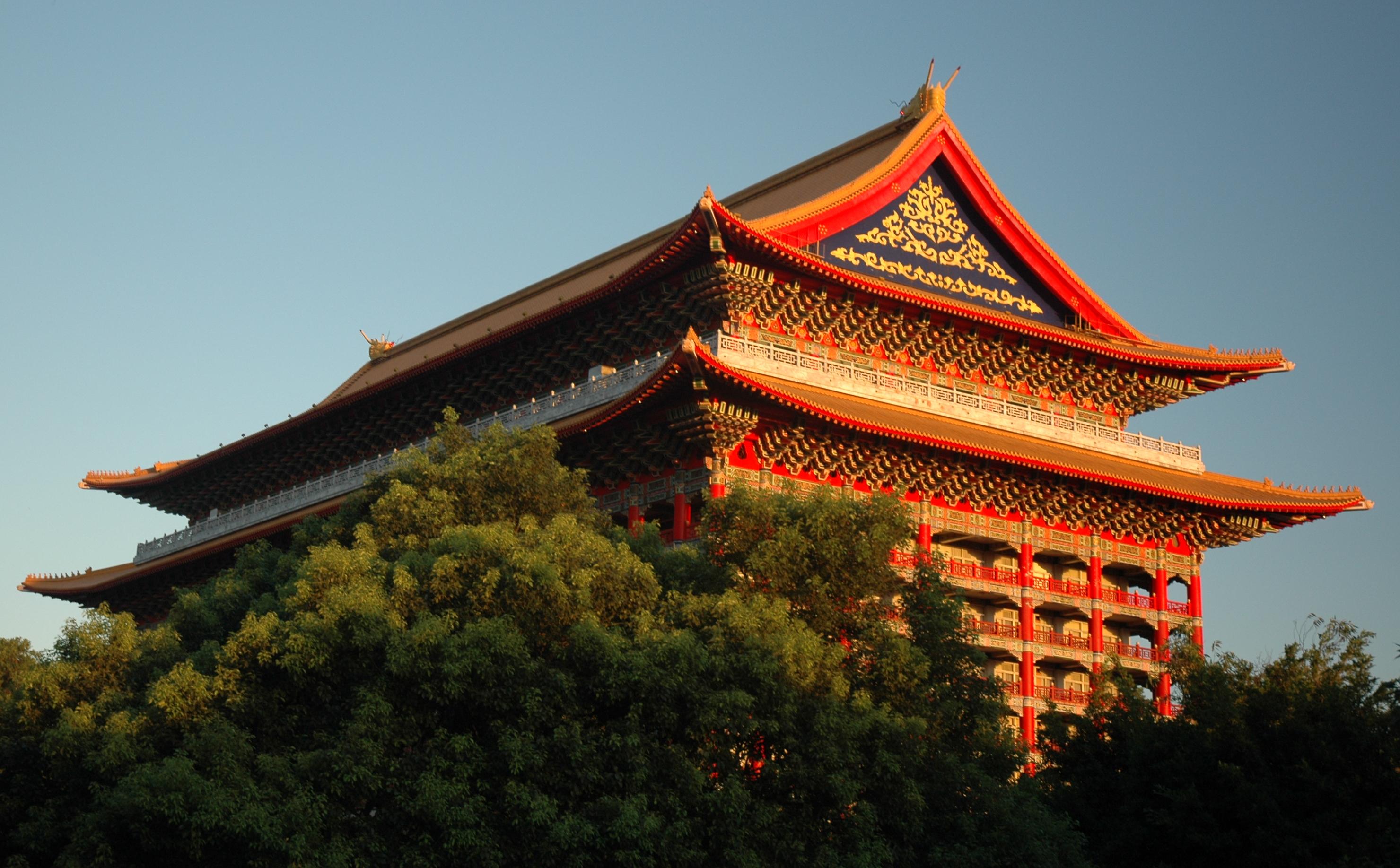
The Grand Hotel, Taipei
The Taipei Grand Hotel was built on the site of the destroyed Taiwan Grand Shrine. This shrine was a Shinto shrine built and used during the days of Japanese rule in Taiwan. Construction of the Hotel began in 1952 but was expanded a number of times until its final completion and dedication on Double Tenth day 1973. (10/10/1973) The Hotel because of its Chinese palace style architecture and the fact that from 1973 until 1981 it was the tallest building in Taipei, became an instant Taipei landmark.

The Hotel can be seen from the Number 1 National Freeway (The Sun Yat Sen freeway) as it crosses over the Keelung River. It is built on the slopes of Yuanshan Mountain, it places the hotel high above the city in a parklike atmosphere. The Hotel has commanding views of Taipei and a number of its landmarks.

Miramar Entertainment Center, backdrop for the drama, Why Why Love
This is a prime spot for a tourist as the Shilin Night Market, and the National Revolutionary Martyrs’ Shrine are nearby. In addition to these popular sites, the Miramar Mall, which was a backdrop for the Huan Huan Ai (Why Why Love) Video Drama starring Rainie Yang, Mike He, Kingone Wang and Michelle Chen, is located nearby with its ferris wheel that that rises high over Taipei.

Chiang Kai Shek, after evacuating the government of the Republic of China to Taipei, was concerned about the lack of suitable accommodations for visiting dignitaries. He decided to build a five-star Hotel to meet those needs. His wife, Sung Meiling suggested this site and according to some sources oversaw the construction and adornment of the building. The intention of the design was to represent Chinese Culture to visitors.

The Dragon, Lion Plum Motif is found throughout the Hotel
Dragon designs are represented throughout the Hotel, resulting in the common name, “The Dragon Palace.” There are many pieces of art, sculpture and painting, throughout the hotel, which reflect this aspect of Chinese Culture. Each of the eight guest floors of the Hotel depicts a different Chinese Dynasty, and uses murals and décor to show the art and life of the particular dynasty.

The décor in the Presidential Suite, which rents for a mere $5,500 USD per night contains President Chiang Kai Sheck’s Desk and Mrs. Chiang’s personal dressing table.

Marble Stairway in the main lobby
One special feature is the two “secret passages” hidden in the hotel. It was rumored that these passages were secret pathways to the official residence of Chiang Kai Sheck. In 1995, a fire that destroyed the top floors of the hotel, caused the hotel to be inspected for safety from top to bottom, it was revealed that these ”secret passages” were actually air raid shelters that led to nearby parks, not the residence of the president. As of 2005 these passages are closed to the public.

Many notable foreign dignitaries have stayed at the Grand Hotel, including Presidents Richard Nixon, Bill Clinton, and Ronald Reagan, Prime Minister Margaret Thatcher, Nelson Mandela and Benigno Aquino Jr., husband of former Philippines president Corazon Aquino on the night before his assassination.

Photo Credits:
Exterior Grand Hotel Taipei:
http://www.cs.columbia.edu/~sedwards/photos/taiwan2004/20040807-2271_Grand_Hotel.jpg

Miramar Mall
http://english.taipei.gov.tw/

All other Photos: Brenda Banducci

Other posts you may be interested in:

Taiwan Travelogue:  The Revolutionary Martyrs' Shrine
Taiwan Travelogue:  The National Palace Museum
Taiwanese History:  The Chiang Kai Shek Mausoleum