I made this video for Scott and Melissa Nied and their family as they left Taoyuan City for Tucson Arizona. They had served as missionaries in both Mainland China and Taiwan for the last fifteen years. On Behalf of the church we appreciate their service and the people you see in these photoes are their legacy. We will do our best to continue to serve Taoyuan City.
When I created this video the sound worked well but for some reason as I uploaded it to Youtube the sound cuts off. I apologize for that.

Thursday, April 29, 2010

Thursday, April 15, 2010
Taiwan Travelogue: Overlooking Tao Yuan City
.jpg)
Tao Yuan City Overview
(click on Images to enlarge)
On the very edge of the city is a small mountain called Hu Tou Shan (Tiger Head Mountain). A while back Emily and I took my scooter up there to look at the city. We took a few photos to give you an idea of what the City we live in is like.
Tao Yuan City, is the county seat for Tao Yuan County. We are approximately 30 km southwest of Taipei City. The population of Taoyuan is approximately 300,000 people; roughly the same population as Riverside California. But it is a much smaller geographic area. Because of the small geographic area the city is built up instead of out. People live in apartment high-rises; one friend lives on the 17th floor of her apartment building. Other people live in homes called Toutians.
 (pronounced Tow teeans) These are homes that are up and down. For example, on the first floor of our home there is a garage and one bedroom and a bathroom. The second floor contains the living room, Japanese tea room, the dining area and the kitchen. The third floor has three bedrooms and the laundry room. The fourth floor is the patio and a bedroom. There are no yards; the house is right on the street. No curb, no gutter the house is built right to the street. The patio on the fourth floor gives people a place to go outside in the evenings when it is a little cooler.
 Tao Yuan City is known for the number of parks it has. There is a city ordinance that says If you own a vacant lot. The lot must either be fenced completely or turned into a park. So parks are everywhere. Other people take that land and put up a temple. You go around a corner and there’s a little neighborhood temple,
 in fact there’s a little temple about a half block from our house. People go there and light incense to their ancestors or leave offerings of fruit for the neighborhood god.
 This photo shows the downtown area. This is the main place for shopping and business. There are a lot of large grocery and department stores in Tao Yuan. The two biggest are Da Ren Fa (which is called RT Mart). Sometimes Feng Shui masters name the stores. Companies pay them to give them a name that will guarantee prosperity. There is another store called Carrefour. Carrefour is a French company and the stores are huge. The one nearest to us is five floors and has everything from appliances to food to clothing to electronics: And just about anything else you could think of. RT mart is the same way, but Carrefour caters more to foreigners, they have foods and merchandise from foreign markets. RT Mart has more Taiwanese style foods and merchandise. We prefer RT mart because it’s closer and usually less expensive.
  There are also a number of Traditional markets in Taoyuan. These places are much like swap meets in Southern California and they have absolutely everything. They are noisy and crowded. Hawkers are calling out what they have for sale. People are everywhere. It gets so crowded that sometimes you can’t get a scooter through. They're outside and Brenda and I love to go there.
Finally there is the night market. These are very popular places in Taoyuan. We have to ride past one twice a week and the place is thronged with people, rain or shine. Mostly they sell Taiwanese snacks and food. But there are also bargains on clothes and other simple things.
Here are a few random photos from the overlook and the road there:

.jpg)
Left: The Twelve Dragons at the Shrine of The Martyr. Right: A large Apartment Complex. (It was a hazy day, not all that is smog.)
.jpg)
.jpg)
Left: A temple on the road leading up the mountain. Right: Winter vegetation on Hu Tou Shan.
Other posts you may be interested in:
Taiwan Travelogue: Old Ceramics Street
Taiwan Travelogue: The Traditional Market
Saturday, April 10, 2010
Random Asianess: Driving in Taiwan
The Taiwanese Driver’s License test.
President Ma Ying Jeoh has declared that the Taiwanese Government workers should work hard to improve English. So they have revised the Taiwanese Driver’s License test. The test was very difficult to take before because of the phrasing of sentences and the word choices. I have placed examples on my Facebook page. But the revisions…well, you tell me if they have improved.
Drivers are required to use distant lights when their vehicles are moving
in the urban areas at night, if the lighting is bright enough.
Distant lights are the High beams
If drivers are intending to maintain an orderly traffic for the safety of the
entire society and for the happiness of their families, they are required to: (1) abide by driving morals and disciplines, (2) improve their driving skills, (3) not smoke and not drink, either.
We can protect the entire society and maintain our family’s happiness by abiding by Driving morals and disciplines.
When meeting other vehicles on the merge-point at night, you are
required to: (1) turn on distant light, (2) turn on near light, (3) turn off lights and yield.
Near light is the low beams.
If drivers speed up, they will be cited in accordance with which of the
following requirement? (1) at least every 4 minutes of speeding up or
the vehicles pass through at least 1 intersection, (2) at least every 5
minutes of speeding up or the vehicles pass through at least 1
intersection, (3) at least 6km after the first citation is issued or at least
every 6 minutes of speeding up or the vehicles pass through at least 1
intersection. The foregoing requirement is not applicable to the tunnels
if vehicles are speeding up therein.
This is talking about the cameras at intersections and next to the road. You are timed and photographed if you are above the speed limit. You can be issued a ticket if after 5 minutes you pass though another inersection and you’re still speeding. You can get a second ticket.
Under which of the following circumstances are drives required to
attend the traffic safety lectures? (1) parking violation, (2) drivers forget
to have their driver’s licences with them, (3) snaki-driving.
Snaki-driving means weaving or swerving between lanes. Or changing lanes repeatedly to pass slower vehicles.
When vehicles are moving at high speed, which of the following is true
about driver’s visions: (1) cannot adapt to the situation definitely, (2)
decrease due to the high speed, (3) increase.
Your vision is unchanged but you travel farther in your reaction time. So you need to be able to see further to be as safe at lower speeds. The correct answer is decrease due to the high speed.
Accidents happen at the turn, because drivers: (1) ignore the blind spots
only, (2) ignore the inner wheel difference only, (3) ignore both the
blind spots and the inner wheel difference.
Inner wheel difference is the turning radius of the vehicle.
Which of the following is eligible for citation by using the movable
scientific instruments? (1) driving on road are required toer, (2) failure to maintain a safety distance, (3) both statements are true.
Toer is not an English word as far as I know.
I didn’t retype these questions I only copied and pasted. Many, many questions have spelling errors. The problem is that the test has been translated by software not by an English speaker; consequently, the people who review it don’t realize that they are using phrases completely foreign to an English speaker. In Chinese the words translated as near light would be easily recognized as the low beams, but in English it isn’t as obvious.
I’m not using this to say, “Look how stupid this is.” I’m using it to demonstrate the kinds of difficulties the language barrier creates. This is one aspect of culture shock. You’re not quite able to communicate easily.
Other posts you may be interested in:
Scootering in Taiwan: New Helmet Technology
Cultural Unawareness: Ticked Off in Taiwan
President Ma Ying Jeoh has declared that the Taiwanese Government workers should work hard to improve English. So they have revised the Taiwanese Driver’s License test. The test was very difficult to take before because of the phrasing of sentences and the word choices. I have placed examples on my Facebook page. But the revisions…well, you tell me if they have improved.
Drivers are required to use distant lights when their vehicles are moving
in the urban areas at night, if the lighting is bright enough.
Distant lights are the High beams
If drivers are intending to maintain an orderly traffic for the safety of the
entire society and for the happiness of their families, they are required to: (1) abide by driving morals and disciplines, (2) improve their driving skills, (3) not smoke and not drink, either.
We can protect the entire society and maintain our family’s happiness by abiding by Driving morals and disciplines.
When meeting other vehicles on the merge-point at night, you are
required to: (1) turn on distant light, (2) turn on near light, (3) turn off lights and yield.
Near light is the low beams.
If drivers speed up, they will be cited in accordance with which of the
following requirement? (1) at least every 4 minutes of speeding up or
the vehicles pass through at least 1 intersection, (2) at least every 5
minutes of speeding up or the vehicles pass through at least 1
intersection, (3) at least 6km after the first citation is issued or at least
every 6 minutes of speeding up or the vehicles pass through at least 1
intersection. The foregoing requirement is not applicable to the tunnels
if vehicles are speeding up therein.
This is talking about the cameras at intersections and next to the road. You are timed and photographed if you are above the speed limit. You can be issued a ticket if after 5 minutes you pass though another inersection and you’re still speeding. You can get a second ticket.
Under which of the following circumstances are drives required to
attend the traffic safety lectures? (1) parking violation, (2) drivers forget
to have their driver’s licences with them, (3) snaki-driving.
Snaki-driving means weaving or swerving between lanes. Or changing lanes repeatedly to pass slower vehicles.
When vehicles are moving at high speed, which of the following is true
about driver’s visions: (1) cannot adapt to the situation definitely, (2)
decrease due to the high speed, (3) increase.
Your vision is unchanged but you travel farther in your reaction time. So you need to be able to see further to be as safe at lower speeds. The correct answer is decrease due to the high speed.
Accidents happen at the turn, because drivers: (1) ignore the blind spots
only, (2) ignore the inner wheel difference only, (3) ignore both the
blind spots and the inner wheel difference.
Inner wheel difference is the turning radius of the vehicle.
Which of the following is eligible for citation by using the movable
scientific instruments? (1) driving on road are required toer, (2) failure to maintain a safety distance, (3) both statements are true.
Toer is not an English word as far as I know.
I didn’t retype these questions I only copied and pasted. Many, many questions have spelling errors. The problem is that the test has been translated by software not by an English speaker; consequently, the people who review it don’t realize that they are using phrases completely foreign to an English speaker. In Chinese the words translated as near light would be easily recognized as the low beams, but in English it isn’t as obvious.
I’m not using this to say, “Look how stupid this is.” I’m using it to demonstrate the kinds of difficulties the language barrier creates. This is one aspect of culture shock. You’re not quite able to communicate easily.
Other posts you may be interested in:
Scootering in Taiwan: New Helmet Technology
Cultural Unawareness: Ticked Off in Taiwan
Sunday, March 28, 2010
The Potter's House, Taoyuan: The British Invasion of Taiwan
The last three weeks I have been very busy with the British Invasion of Taiwan. You’re not going to read about this in the Drudge Report or see it on the news. In fact, I’m probably your only source of news on this event. The British have invaded Taiwan.
 A team of Gospel Commandos from South London arrived at Chiang Kai Shek International Airport on Tuesday March 16. These people had paid their own way to travel to Taiwan in support of the Taoyuan City church. We had a busy schedule planned and intended to maximize their investment by reaching as many people as possible with the Gospel.
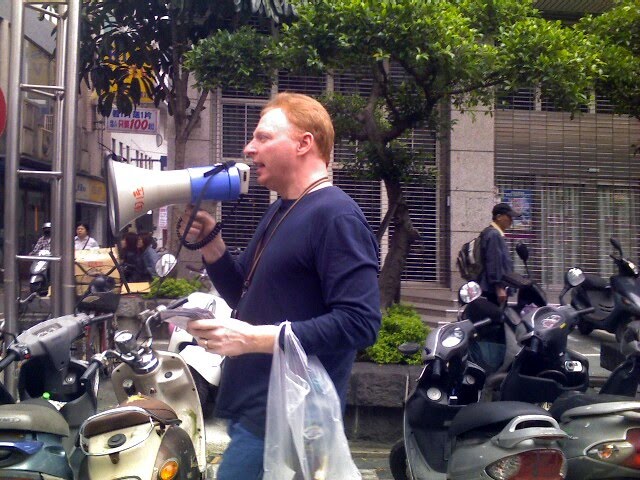
Wednesday morning we met for prayer and then went to the Traditional market where we outreached for several hours for the regular coffee shop and the revival that was planned for the weekend. The outreach proved to be successful as we saw visitors at the coffee house that came from the outreach. Pastor Peter Ajala taught English Wednesday night and ministered from the Bible a lesson on the parable of the soils. Four people prayed to receive Jesus that night.
 The following day we met on the streets of Downtown Taoyuan in the evening for an open-air street meeting. We sang Praise and Worship songs to establish dominion and street preached gave testimonies and witnessed one-on-one in the streets. We saw 7 decisions for Jesus that night.
 Friday afternoon, we were in the streets again for one-on-one witnessing and outreaching for the revival. Friday night we saw visitors and Pastor Ajala preached and we saw people getting saved.
Saturday, the Zhongli church joined us for street drama and preaching in the downtown area. One drama where the devil weighed down a victim with various sins, until Jesus showed up and took the burden on himself, literally stopped traffic in the street.
One man, who had gotten saved on Wednesday at the coffee house, joined us to outreach on Saturday.
Sunday, the revival wrapped up and the team after a day of rest left to go home. This was a huge boost for the church as we gained momentum and eagerly planned for our own street dramas and music groups. In all 26 people gave their lives to Jesus in this week and we have seen some of them return to church on their own this week. Thanks to Pastor Ajala and his team for their investment in our city and our congregation. What a blessing to be part of a fellowship where churches will partner together. We have big plans for their return November 2011.


 A team of Gospel Commandos from South London arrived at Chiang Kai Shek International Airport on Tuesday March 16. These people had paid their own way to travel to Taiwan in support of the Taoyuan City church. We had a busy schedule planned and intended to maximize their investment by reaching as many people as possible with the Gospel.
Wednesday morning we met for prayer and then went to the Traditional market where we outreached for several hours for the regular coffee shop and the revival that was planned for the weekend. The outreach proved to be successful as we saw visitors at the coffee house that came from the outreach.
 Pastor Peter Ajala taught English Wednesday night and ministered from the Bible a lesson on the parable of the soils. Four people prayed to receive Jesus that night.
 The following day we met on the streets of Downtown Taoyuan in the evening for an open-air street meeting. We sang Praise and Worship songs to establish dominion and street preached gave testimonies and witnessed one-on-one in the streets. We saw 7 decisions for Jesus that night.
 Friday afternoon, we were in the streets again for one-on-one witnessing and outreaching for the revival. Friday night we saw visitors and Pastor Ajala preached and we saw people getting saved.
Saturday, the Zhongli church joined us for street drama and preaching in the downtown area. One drama where the devil weighed down a victim with various sins, until Jesus showed up and took the burden on himself, literally stopped traffic in the street.

One man, who had gotten saved on Wednesday at the coffee house, joined us to outreach on Saturday.
Sunday, the revival wrapped up and the team after a day of rest left to go home. This was a huge boost for the church as we gained momentum and eagerly planned for our own street dramas and music groups. In all 26 people gave their lives to Jesus in this week and we have seen some of them return to church on their own this week. Thanks to Pastor Ajala and his team for their investment in our city and our congregation. What a blessing to be part of a fellowship where churches will partner together. We have big plans for their return November 2011.


Tuesday, March 2, 2010
Reaching Milestones: A Personal Note
Last week, my wife and I reached a milestone in our marriage. We celebrated our fifteen-year anniversary. This was a powerful moment for me who had given up on the idea of ever having a wife and a family. What a joy to be able to look back fifteen years and see the miracle that God did in my life. A man who had given up on life is renewed through the power of God to change lives. This is one thing that sets Christianity apart from other religions. God is not a statue or image that capriciously makes decisions about whether to bless or curse: The God that changes lives is not an idol that demands worship, but instead is a personal God who has compassion and concern for his creation. That’s why he cared enough to sacrifice his son as the remedy for our rebellion and sin.
This is why I’m excited to be able to minister in a place like Taiwan. A place where people struggle under the bondage of serving gods, that don’t know them or have any regard for their welfare. My daily prayer is that God will demonstrate his miracle power through my ministry. That people will see the compassion of God as well as his ability to change lives and fortunes. No idol can do that. No philosophy can do that. Only the God that created the universe with a word can do that.
So thanks to God for giving me a marriage that can be sustained over 15 years. Thanks to God for a wife that can put up with me day in and day out for all those years. Thanks to God for children who love and care for me. God let me be a good husband and father for many more years to come. Thank you Brenda, for your love and loyalty all these years. Thank you Elizabeth, for being an obedient and cheerful child, who is able to absorb all the changes in your life. Thank you Emily, for being a “Daddy’s Girl” who even though you struggle with certain things, you really try to overcome.
I know some of the things that have taken place recently have been an upheaval in your lives. But thanks to all three of you for allowing me to follow God’s call on my life. I love and appreciate all of you.
This is why I’m excited to be able to minister in a place like Taiwan. A place where people struggle under the bondage of serving gods, that don’t know them or have any regard for their welfare. My daily prayer is that God will demonstrate his miracle power through my ministry. That people will see the compassion of God as well as his ability to change lives and fortunes. No idol can do that. No philosophy can do that. Only the God that created the universe with a word can do that.
So thanks to God for giving me a marriage that can be sustained over 15 years. Thanks to God for a wife that can put up with me day in and day out for all those years. Thanks to God for children who love and care for me. God let me be a good husband and father for many more years to come. Thank you Brenda, for your love and loyalty all these years. Thank you Elizabeth, for being an obedient and cheerful child, who is able to absorb all the changes in your life. Thank you Emily, for being a “Daddy’s Girl” who even though you struggle with certain things, you really try to overcome.
I know some of the things that have taken place recently have been an upheaval in your lives. But thanks to all three of you for allowing me to follow God’s call on my life. I love and appreciate all of you.
Eating My Way Through Taiwan: Japanese Barbeque
The Japanese Barbeque
This year we celebrated our anniversary by going to a Japanese Barbeque Restaurant. There are a number of these restaurants in Taoyuan City. The one I like to go to is maybe 5 blocks from our home. The restaurant is an “All-You-Can-Eat” place, where you cook at your table. You barbeque meats and cook Hot Pot. (See the Hot Pot post below)
You order based on three different menus of escalating prices. The prices vary based on the variety of meats that you desire. I always go with the lowest priced menu. For $299 NT Dollars (approximately $9.00 USD) per person you receive: All you can eat Beef, Pork, Chicken, To Gan (A type of Tofu), and Tian Bu La (Processed fish cake), a Hot Pot, salad, two types of desert and drinks. What a great value. Hot Pot alone costs $250 NT at a Hot Pot restaurant.
 As you walk into the restaurant, the workers prepare a table for you. They put charcoal into the barbeque pit at your table and light the igniters and the charcoal begins to heat up. The barbeques usually have an exhaust hood like the hood on your cook top at home. A fan pulls the smoke up into the hood and it is vented outside of the restaurant. The problem is that most of the time the hood is between you and your guest, and it’s noisy. In this particular restaurant, the exhaust hood is built into the table. The smoke is pulled out before it leaves the barbeque. There is no conversation blocking exhaust hood in your face. You can easily talk and see the person you’re with.
After you order, the workers then go in the back and prepare your Hot Pot with all the usual ingredients: Processed Fish Cakes, Mushrooms, Cabbage, Shrimp, Duck blood (I can do without the Duck blood) and broth.
The fire is lit and the pot set on the boil. While this is happening you can go back and prepare your barbeque sauce. It’s similar to the hot pot sauce but a little sweeter with citrus slices in it. Then they begin to bring the meat… and bring the meat…and bring the meat, until you cry “Uncle” and tell them to stop.
 The meat is thinly sliced and quickly barbequed. You season with salt and pepper, and then use your chopsticks to dip the meat into the “Barbeque Sauce” you made up earlier. I use the same sauce to dip my Hot Pot ingredients into. What a feast. But that’s not the end of it.
After you stop the meat flow, the workers prepare a desert that is made from a small loaf of doughy bread that is sprinkled with a sweet peanut powder and a type of sauce and heated. This is delicious when eaten hot. Our waitress warned us that if it gets cold, “You won’t want to taste it.” Then another desert is brought that consists of small doughy bars that are heated on the barbeque and then dipped into the sauce and peanut powder.

I can’t tell you the name of the restaurant because it is written in Chinese Characters and I don’t know all the characters in the name. But, if you come here I’ll make sure you get to visit this place. This place is highly recommended by Larry Beaureguard, if you know him you can ask him about it. If you’re a local it’s right across from Yang Ming Park on Changsha Road at the end of the block.
Other posts you may be interested in:
Eating My Way Through Taiwan: A Traditional Restaurant
Eating My Way Through Taiwan: Hot Pot

This year we celebrated our anniversary by going to a Japanese Barbeque Restaurant. There are a number of these restaurants in Taoyuan City. The one I like to go to is maybe 5 blocks from our home. The restaurant is an “All-You-Can-Eat” place, where you cook at your table. You barbeque meats and cook Hot Pot. (See the Hot Pot post below)
You order based on three different menus of escalating prices. The prices vary based on the variety of meats that you desire. I always go with the lowest priced menu. For $299 NT Dollars (approximately $9.00 USD) per person you receive: All you can eat Beef, Pork, Chicken, To Gan (A type of Tofu), and Tian Bu La (Processed fish cake), a Hot Pot, salad, two types of desert and drinks. What a great value. Hot Pot alone costs $250 NT at a Hot Pot restaurant.
 As you walk into the restaurant, the workers prepare a table for you. They put charcoal into the barbeque pit at your table and light the igniters and the charcoal begins to heat up. The barbeques usually have an exhaust hood like the hood on your cook top at home. A fan pulls the smoke up into the hood and it is vented outside of the restaurant. The problem is that most of the time the hood is between you and your guest, and it’s noisy. In this particular restaurant, the exhaust hood is built into the table. The smoke is pulled out before it leaves the barbeque. There is no conversation blocking exhaust hood in your face. You can easily talk and see the person you’re with.
 After you order, the workers then go in the back and prepare your Hot Pot with all the usual ingredients: Processed Fish Cakes, Mushrooms, Cabbage, Shrimp, Duck blood (I can do without the Duck blood) and broth.

The fire is lit and the pot set on the boil. While this is happening you can go back and prepare your barbeque sauce. It’s similar to the hot pot sauce but a little sweeter with citrus slices in it. Then they begin to bring the meat… and bring the meat…and bring the meat, until you cry “Uncle” and tell them to stop.
 The meat is thinly sliced and quickly barbequed. You season with salt and pepper, and then use your chopsticks to dip the meat into the “Barbeque Sauce” you made up earlier. I use the same sauce to dip my Hot Pot ingredients into. What a feast. But that’s not the end of it.
After you stop the meat flow, the workers prepare a desert that is made from a small loaf of doughy bread that is sprinkled with a sweet peanut powder and a type of sauce and heated. This is delicious when eaten hot. Our waitress warned us that if it gets cold, “You won’t want to taste it.” Then another desert is brought that consists of small doughy bars that are heated on the barbeque and then dipped into the sauce and peanut powder.

I can’t tell you the name of the restaurant because it is written in Chinese Characters and I don’t know all the characters in the name. But, if you come here I’ll make sure you get to visit this place. This place is highly recommended by Larry Beaureguard, if you know him you can ask him about it. If you’re a local it’s right across from Yang Ming Park on Changsha Road at the end of the block.
Other posts you may be interested in:
Eating My Way Through Taiwan: A Traditional Restaurant
Eating My Way Through Taiwan: Hot Pot
Tuesday, February 23, 2010
Random Asianess: Walking the god
(Click on images to enlarge.)

Yesterday, the gods went for a walk through our neighborhood. This is done after Chinese New Years, and other times to rid the homes in the neighborhood of evil spirits. It is an interesting and noisy process.
Beginning early in the morning we began to hear the retorts of firecrackers. Not just a few individual bangs. Do you remember those times where you would light the fuse of an entire package of Black Cat Firecrackers and thirty-two firecrackers would blast one after another in rapid-fire succession? B-r-r-r-r-aaap. Take that sound and multiply by about three thousand blasts every two hours beginning at midnight.
Then we started hearing the music. It sounds eerie, like bagpipes with drums and cymbals. The group begins to walk through the neighborhood. The firecrackers serve two purposes the first is to arouse the evil spirits and the second is to let the neighborhood know that this is taking place.
The neighbors began to bring incense burners, and small incinerators out to the street. These are used to make offerings to their dead ancestors. They burn money purchased from the temple, small paper clothing and other things that their ancestors would need as they wait in hell to be reincarnated. I’m not using hell in a derogatory way here. The belief is that everyone dies and unless they have become an ascended master who has arrived at nirvana, they go to hell to await reincarnation.
But while they are in hell they have the same material needs that they would have on earth. This is why when they are buried there are the stacks of beers, or offerings of a favorite food. They have a need for money, clothing and food and they believe that the incinerator is the portal or doorway to their ancestor’s soul. So the items are burned and the smoke carries the essence of the thing to the ancestor. In fact, every year there is a month called Ghost Month where the people believe that their ancestor’s ghost is released from hell to wander the earth. So they prepare meals for the ghosts and place them outside the door of the house for them to eat.
Because of these beliefs it is important to teach the children to “provide for the ghosts” of their ancestors. The worst thing that can happen to a person is that they become a “hungry ghost” doomed to wander the spirit realm without provision. So children are taught respect for ancestors and threatened with curses and evil spirits if they don’t provide for them. People are deathly afraid of ghosts in Taiwan. The problem for them is that they are always afraid that they haven’t been faithful enough in providing for the ancestors.
Which brings us back to the walking of the gods. The purpose of the walk is to free the neighborhood homes of evil spirits. So as the gods stroll through the neighborhood, every home where there is an incense burner or incinerator the parade stops there and the lions go into that house and frighten away the evil spirits.

In the parade are lions, walking characterizations of the gods of hell. Musicians, drummers, an ark carried by four men and a singer. The musicians and singer provide a background of worship and honor for the gods.


At the head of the parade are firecrackers and fireworks; these are lit to frighten the evil spirits. After the fireworks come the horn players and the singer. Then come the lions, these are sent into the homes to chase out the evil spirits to the gods waiting in the streets.
The ark follows all of this. The ark is a portable altar. It is used to hold offerings to the gods and perhaps as a holding facility for the evil spirits. The parade is ends with people following the ark and burning incense.
 The music sounds like ancient Chinese music or the music of India. Buddhism has its roots in India as the founder of Buddhism, the Buddha himself, was an East Indian man named Siddhartha Guatama who lived in 598 BC.

When your home is rid of spirits it is expected that you will give the temple a Hong Bao (red packet). A donation placed in a red packet is offered to the temple for this service.
Other posts you may be interested in:
Local Color: The Temples of Taoyuan City
Taiwanese Traditions: Ghost Month

Yesterday, the gods went for a walk through our neighborhood. This is done after Chinese New Years, and other times to rid the homes in the neighborhood of evil spirits. It is an interesting and noisy process.
Beginning early in the morning we began to hear the retorts of firecrackers. Not just a few individual bangs. Do you remember those times where you would light the fuse of an entire package of Black Cat Firecrackers and thirty-two firecrackers would blast one after another in rapid-fire succession? B-r-r-r-r-aaap. Take that sound and multiply by about three thousand blasts every two hours beginning at midnight.
Then we started hearing the music. It sounds eerie, like bagpipes with drums and cymbals. The group begins to walk through the neighborhood. The firecrackers serve two purposes the first is to arouse the evil spirits and the second is to let the neighborhood know that this is taking place.

The neighbors began to bring incense burners, and small incinerators out to the street. These are used to make offerings to their dead ancestors. They burn money purchased from the temple, small paper clothing and other things that their ancestors would need as they wait in hell to be reincarnated. I’m not using hell in a derogatory way here. The belief is that everyone dies and unless they have become an ascended master who has arrived at nirvana, they go to hell to await reincarnation.
But while they are in hell they have the same material needs that they would have on earth. This is why when they are buried there are the stacks of beers, or offerings of a favorite food. They have a need for money, clothing and food and they believe that the incinerator is the portal or doorway to their ancestor’s soul. So the items are burned and the smoke carries the essence of the thing to the ancestor. In fact, every year there is a month called Ghost Month where the people believe that their ancestor’s ghost is released from hell to wander the earth. So they prepare meals for the ghosts and place them outside the door of the house for them to eat.
Because of these beliefs it is important to teach the children to “provide for the ghosts” of their ancestors. The worst thing that can happen to a person is that they become a “hungry ghost” doomed to wander the spirit realm without provision. So children are taught respect for ancestors and threatened with curses and evil spirits if they don’t provide for them. People are deathly afraid of ghosts in Taiwan. The problem for them is that they are always afraid that they haven’t been faithful enough in providing for the ancestors.
Which brings us back to the walking of the gods. The purpose of the walk is to free the neighborhood homes of evil spirits. So as the gods stroll through the neighborhood, every home where there is an incense burner or incinerator the parade stops there and the lions go into that house and frighten away the evil spirits.

In the parade are lions, walking characterizations of the gods of hell. Musicians, drummers, an ark carried by four men and a singer. The musicians and singer provide a background of worship and honor for the gods.


At the head of the parade are firecrackers and fireworks; these are lit to frighten the evil spirits. After the fireworks come the horn players and the singer. Then come the lions, these are sent into the homes to chase out the evil spirits to the gods waiting in the streets.

The ark follows all of this. The ark is a portable altar. It is used to hold offerings to the gods and perhaps as a holding facility for the evil spirits. The parade is ends with people following the ark and burning incense.
 The music sounds like ancient Chinese music or the music of India. Buddhism has its roots in India as the founder of Buddhism, the Buddha himself, was an East Indian man named Siddhartha Guatama who lived in 598 BC.
When your home is rid of spirits it is expected that you will give the temple a Hong Bao (red packet). A donation placed in a red packet is offered to the temple for this service.
Other posts you may be interested in:
Local Color: The Temples of Taoyuan City
Taiwanese Traditions: Ghost Month
Subscribe to:
Posts (Atom)