 |
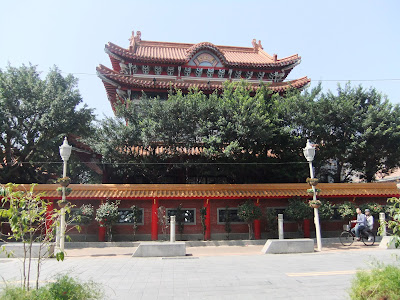
| The Confucius Temple as seen from the street |
Confucianism is a very complex system of beliefs. It isn’t just a religious philosophy but also contains elements of moral, social and political thought. The goal of Confucianism is the perfect man; a virtuous man of great learning and good manners; A scholar, a gentleman and a saint. The notion of duty extends beyond moral thought and is expected to be a part of everyday life. Confucius (551 B.C. – 479 B.C.) was a contemporary of Siddhartha Guatama, who is also known as the Buddha. Buddha died two years before Confucius at the age of 80. Confucius was not popular in his lifetime. He attempted to infuse government with his philosophies of duty and honor only to be rebuffed continuously. After his lifetime, though, he became venerated as the “perfect man:” The greatest of men and a flawlessly wise man. Confucius for his part had no illusions as to his perfection. He was a man who was aware of his shortcomings and made no great effort to keep them hidden.
Confucian Belief
 |
| An Example of Confucian Thought: See no Evil, Speak no Evil, Hear no Evil |
Confucian beliefs not only exemplify the teachings of Confucius but also strongly rest on ancient Chinese tradition. The religion of ancient China to which Confucius adhered closely was a form of nature-worship. While numerous spirits associated with natural phenomena were recognized—spirits of mountains and rivers, of land and grain, of the four quarters of the heavens, the sun, moon, and stars—they were all inferior to the supreme Heaven-god, Tian (Heaven) also called Ti (Lord), or Shang-ti (Supreme Lord). All other gods were his ministers.
Many of the Confucian teachings are written in the Five King Books. In the first of these is the "Shao-king" (Book of History). It’s a religious and moral book, teaches the lessons that the Heaven-god gives prosperity only to the virtuous ruler who has the welfare of the people at heart. This is primary to the work of Confucius in government. During his lifetime he worked to change government according to the principles that have been written in this book.
 |
| Women making an offering to their ancestors at Pao An Temple |
One aspect of Confucian thought is that, “man is basically good.” It is believed that any man is able to follow the path of duty, and live within the rules of good conduct, provided that his nature is not spoiled by environment or bad influences. Confucianism does not hold to the belief of original sin.
Central to the idea of Confucianism is the worship of ancestors. Many of the modern traditions of ancestor worship may be traced back to Confucian thought. Ghost month, offerings to ancestors, tomb sweeping and the burning of “temple” money are centered in Confucianism.
Ancient Confucian Ceremonies
Marriage – Marrying and having a MALE child is the duty of a good son. The parents through a go-between arranged the marriage. The man should be 30 and the woman 20. On the wedding day the groom in his best clothing and carriage comes to the bride's house and leads her to his carriage. She is taken to his father’s home where guests have gathered. The bride and groom are given cups made of hollowed out fruit and filled wih sweet liquors when they drink from it they signify they are onded in marriage.
 |
| Ghost Month Offering |
Mourning Ceremonies - The mourning rites were also of great importance. The mourning rites for the father were the most impressive of all. For the first three days, the son, clad in sackcloth of coarse white hemp, fasted, and leaped, and wailed. After the burial, the son had to wear the mourning sackcloth for twenty-seven months, starving himself and living in a crude hut made for the funeral near the grave. Confucius condemned the suggestion that the period of the mourning rites be shortened to one year.,
Sacrifices – The sacrifices are mainly food offerings set out to the gods or ancestors. The sacrifice was to be nothing more than a food offering expressing the respect of the worshippers, a solemn feast to do honor to the spirit guests, who are invited and are thought to enjoy the entertainment. Fruit, meat and drinks, including alcoholic beverages are included in the offerings There is singing and instrumental music, and dancing. The ministers in these ceremonies are not priests, but heads of families, the feudal lords, and above all, the king.
Things have changed a bit in modern times. Weddings are done in a restaurant. Ratified by the government and are no longer arranged by the parents (in most cases) Funerals are still usually a month longs and include wailing and chanting, traditional music and offerings for the dead. Usually a tent is set up in front of a person's home and some religious rites ae done in the tent. Often there are professional mourners who lead the family in wailing for their dead relative.
Food offerings are done mainly on specific holidays. For example there are three days during Ghost month (July 1, 15 and 30on the Lunar Calendar). In addition, there is a day of Sweeping of the ancestor’s tombs. (April 5 solar) On other occasions people burn money and offer sacrifices such as food, fruit, drinks and incense for their ancestors.
The Temple in Taipei
 |
| Gateway into the Confucius Temple |
The temple was first built in 1879 to serve the people in the rites of Confucianism. In 1907 the Japanese destroyed it. At that time Japan was the “owner nation” of Taiwan. The rights to govern Taiwan were given to the Japanese in 1895 following the first Sino-Japanese conflict. The temple was torn down in order to make way for the Taipei First Girls High School. It was rebuilt in its present location in 1925.
On September 28, the birthday of Confucius, officials hold the Shidian ceremony. These ceremonies began in the Zhou dynasty and include ritual offerings of food and drink as well as traditional dances and music. In addition to Confucius, the ceremony also honors the four companions and the twelve “wise ones,” disciples of Confucius. Their “spirit Tablets” (this is a wooden tablet where the spirit of the decased reside, in the Confucian belief system) are placed east and west of Confucius’ spirit tablet. Modern Cofucian sages and ancient ones are honored together.
Other posts you may be interested in:
Taiwanese Traditions: Ghost Month
Random Asianess: Walking the god
Taiwanese Traditions: The Legend of Nian