Wednesday, October 30, 2013

That is one BIG Duck

It's an inflatable duck, but not a big inflatable duck.
I've been reading about this giant rubber duck for a while, now.  I first heard about it when it was in Sydney, Australia.  That was in 2007.  It looks just like the rubber duck you played with in the tub when you were a kid.  Well, some of you, I know you still play with that thing. 

I was pretty excited to see it.  The duck, created by Dutch conceptual artist Florentijn Hofman made it’s first appearance in 2007 in Sydney Harbor and its been in a number of places since.  Recently, it was in Southern Taiwan in the city of Gaoxiong, but now it’s right here in Northern Taiwan in a little place called Xinwu. The duck will be there from October 26 (2013) until November 10. 

According to things that I've read, the artist doesn't send the duck but sends plans for the duck, which are then implemented in the host country.  The duck in Taiwan was inflated in just seven minutes, thanks to technology developed here.  When the duck was in Hong Kong harbor it took an hour to inflate. Can you imagine the volume of air that had to be moved to inflate a duck that’s 58ft by 58ft by 81ft that’s 272,484 cubic feet (83,841 cubic meters) in seven minutes?  I’m guessing they didn't just use the vacuum on blow. 

The duck peers out over the crowd.
We decided that we couldn't let the duck be this close and not go see it.  Even my teenage daughters were kind of excited about it.  Of course, they have fond memories of their little rubber ducks.  When they were babies I would play with the ducks with them while they soaked in the bathtub.  In fact, their first word was duck.  Most parents get “mama” or “dada,” we got duck.”

This duck is a bit bigger than they’re used to, though.  The duck is 18 meters high, that’s 58 feet for you on the English measuring system, and 25 meters long (81 feet).  That is one big duck, so you would need a big, big tub to play with it in.

We also got on the news as being the only foreigners in the place.  There were probably 10,000 people who went to see the duck today, which is pretty surprising for a work/school day.  The first day it was opened was a Saturday and 100,000 people passed by and gazed upon the duck in all its hugeness and glory.  In fact, they opened the art festival an hour early, because by 8:00 am, they already had a line more than three kilometers long.  They’re expecting 1.5 million visitors before the end of the run.  Xinwu is a small rural community, especially by Asian standards; only 48,000 people live there. 

Duck Souvenirs
It was a great trip.  There was a great carnival atmosphere, with food vendors and souvenir vendors and other artworks on display.  People were happy and enjoying the autumn weather.  This is the absolute best time to be in Taiwan weather-wise. 

Access for handicapped people was provided, but you couldn't easily get too close to the duck.  There was an area that was like a deck that was reserved for elderly and handicapped people.  there were also volunteers and staff to enforce that it wasn't packed with able bodied people, so there was actual room for the elderly and disabled

If you live in Northern Taiwan, take some time to visit Xinwu while the duck is there.  We had a wonderful time.  Admission to the Taoyuan Land Art Festival, that’s where the duck is, is free.  I’d pay at least twice that for the opportunity to see it all again.

They've got all their ducks in a row.


Delicious Squid on a Stick.


Duck Watchers


Other posts you may be interested in:

Local Color: A Winter Trip to Danshui
Local Color:  Ju Ming Museum in Taipei

Photos by Emily Banducci

Saturday, October 19, 2013

Cruising Around: Exploring Close to Home.

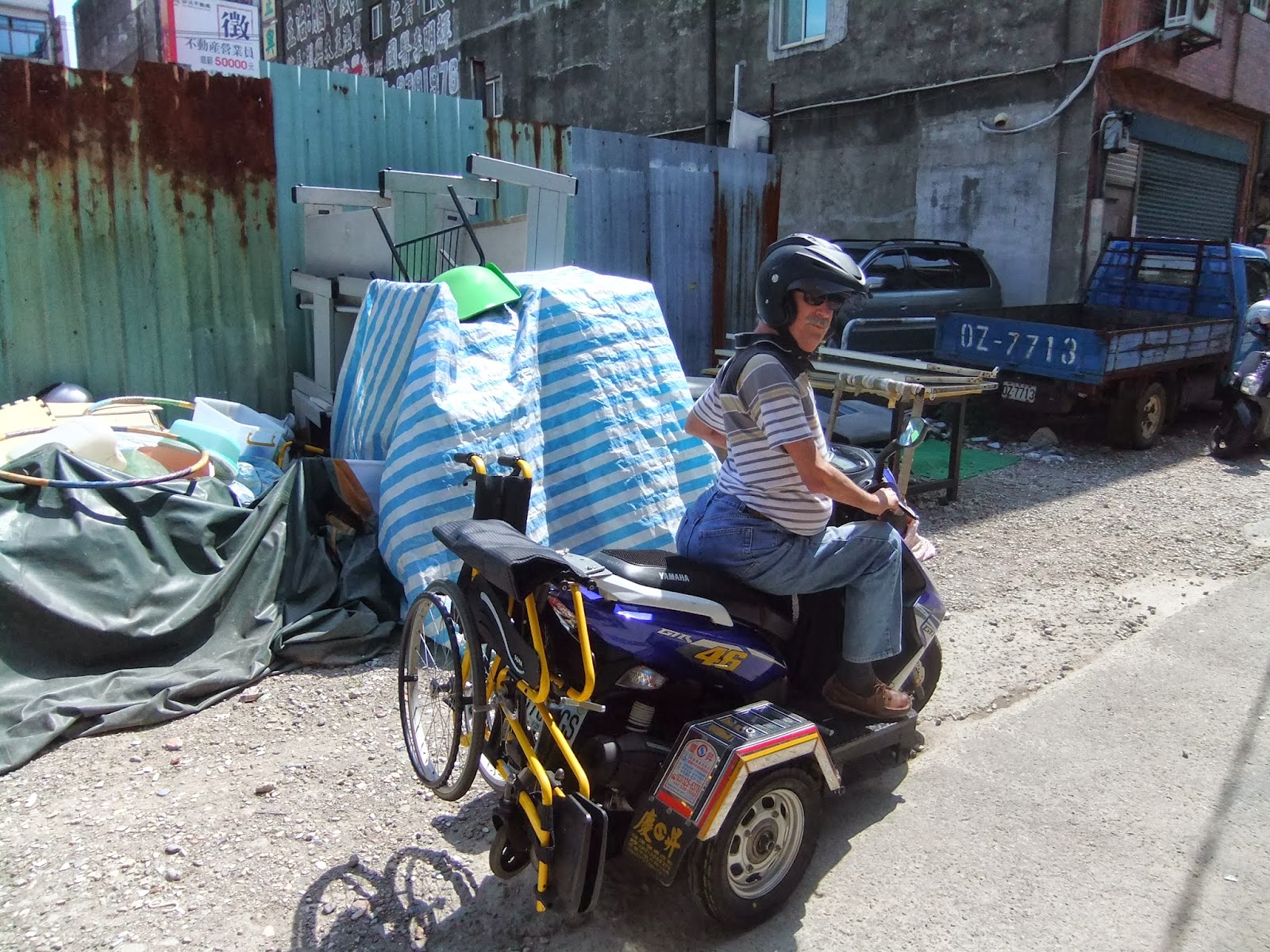
Have Wheelchair will Travel
The weather here has become Autumn weather.  So the temperature has come down, a fresh little breeze is blowing and the weather is perfect for a cruise on the the old scooter.  So after I got back from my morning trip to downtown Taoyuan I decided to hit the open road.  I took a few pictures of some things that I thought were interesting or beautiful, or both, as the case may be.  I've recently been spending quite a bit of time looking at photographer Craig Ferguson's travel photos.  His photos are so good that I'm almost intimidated to take pictures.  His are art, mine should be in your grandmother's scrapbook.  You can see Craig's excellent photos at http://www.craigfergusonimages.com  and you'll see why I'm intimidated.

To be perfectly honest, I'm not that good a photographer, basically because I'm lazy.  I have a small digital camera and mostly take snapshot like photos.  I'm wanting to get a really good, digital camera, like a canon rebel with a 55mm to 128mm lens or some other technical stuff.  I had a nice SLR film camera, but film is a pain when you're using it to blog.  So, I guess I'm not too technical when it comes to cameras.  I have a friend who's so technical that he uses only numbers when he talks.  Anyway such as they are, here are my photos and a brief description


These three photos above are a a large Taoist temple.  I found this temple by following a line of lanterns hung from the telephone poles.  The lanterns are red and spherical.  They're the common lanterns that are sold in Chinese gift shops across America.  They have a purpose beyond decoration and that purpose is to point out the location of a temple.  If you see lanterns strung down the side of a road and follow them they will end at a temple site.


This is a photo of the garden in front of my apartment community.  Many apartments have a beautiful park like Garden for the residents to enjoy.  My daughter Elizabeth loves to take her laptop down to the garden to do her schoolwork.  I have on occasion sat down there in the morning to pray.  It's really very beautiful. 


This stream seems to appear out of nowhere.  On one side of the road is the pond in the picture above where the temple roof can be seen and on the other side of the road is this stream.  But I can't see what feeds the pond.  It's just there, then this stream.  But the stream isn't a trickle it's a pretty good sized creek.  In order to find the source, I'm probably going to have to get off the bike and explore, but I think it would be hard with a wheel chair.  You can see the brush is fairly thick.  So...I guess I'll have to make Emily and Elizabeth do it.


You can see how close I am to the city right here.  This is about three quarters of a kilometer from my apartment.  Elizabeth found this place while walking her dog.


This is the same field as the one in the picture above.  The birds are called Egrets, in English, I don't know what they're called in Chinese.  These are the birds that are often depicted in Chinese art.  Usually they're called Cranes, although, I don't believe they are Cranes in a  taxonomic sense.


The first photo in this group of two is a photo of an altar.  You can see on the altar is a small incense urn, with sticks of incense sticking out of it.  There is a statue of the Goddess on there as well.  So people in this small neighborhood probably burn incense the local deity here.  The incense sticks tell me that someone worshiped here before I came this morning.  The bottom photo is of a couple of family tombs.  These two tombs are beautifully cared for.  You cans see an incense urn and two vases for flowers on the one on the left.  The character in the circle on the top of the one on the right is Wang, a family name, which translates to King.


After I left this road, I circled back and went about 2 kilometers down another road, which leads to a city called Ping Zhen (Ping Jun).  As I came out of the city I came across another stream and found this guy fishing.


A little farther down I came across this apartment community.  the interesting thing here is that this community has a private temple for worshipers living in the community.  I haven't often seen that.


Finally, as I turned toward my own community, I came across this cool little car.  This car is run by a dog grooming company who apparently comes to your house to groom your dog.  You see a lot of these little "VW buses".  They're made from a kit.  I've seen a number of them outfitted for serving hot food off the back.  the panels fold up and in to reveal a propane grill and preparation table.  I've even seen one made to be a small van.  They used a pink one as a van in an Idol Drama, starring Joe Cheng and Ariel Lin called, "It Started with a Kiss."  I like the little paw print shaped vents on this one.

Photos by Chris and Emily Banducci

Other posts you may be interested in:

Clearing Out the Camera:  Random Shots of Taiwan
Local Color:  The Color is Green
Local Color:  The Colors of Kenting
Local Color:  The Temples of Taoyuan City

Monday, October 7, 2013

The Origins of Wulong Tea?

Look at the beautiful, clear yellow of the Wulong Tea.
The word Wulong (Oolong; in Chinese 烏龍) is literally translated as black dragon.  So what we call Wulong tea means Black Dragon Tea.  I've pondered this many times.  Wulong tea is closer to a green tea type tea.  It looks like a green tea when brewed as it has a beautiful clear golden yellow color.  It also looks like a green tea in its prior to brewing.  So why call it Black Dragon Tea.

Because the origin of Wulong tea is shrouded in the mists of antiquity there are three theories about how Wulong Tea came to have that name.  But in my mind, one seems more likely from a historical perspective.

The first theory is that it was first cultivated in the Wuyi Mountains(武夷山) of Fujian Province in China during the Ming Dynasty.  Evidence comes in the form of two poems published during the Qing Dynasty which followed.  The Qing Dynasty started in 1644 and ended with the Xin Hai revolution in 1912, when the empress dowager abdicated the throne on behalf of her son the emperor.

The first is called the Wuyi Tea Song by Yi Chaogun

In the fifteenth century
Tea fields were abandoned
As some of the rock tea starts to grow
The love it when the North wind
Starts to blow on a sunny day
But not the South wind or rain
The fragrance dissipates
The beautiful Plum and Orchid Aroma
Come from the final baking process

The second is called Tea Tale by Wang Chaotang

Wuyi Tea is left to sun in a bamboo basket
Then roasted and baked
Longjing tea is pure because it is roasted but not withered
Only Wuyi tea is roasted and withered
Half green and half red
Roasted green and withered red
Left to wither then shaken
When the fragrance emerges; it is roasted
The timing has to be precious

This theory seems most plausible to me as these poems seem to chronicle the processing of Wulong Tea.  The process for preparing Wulong Tea is still the same today:

  1. It’s picked by hand.
  2. Left in a basket in the sun to oxidize.
  3. It’s rolled into balls
  4. Baked in an oven

Black Tea (front) is in leaf form, the Wulong Tea (rear) is rolled into balls.
It’s important to know that Green, Black and Wulong Tea come from the same plant.  The differences are in the fermenting or oxidizing of the leaves.  Green Tea is not oxidized, and black tea is fully oxidized.  Wulong tea is partially oxidized.  So as the poem says it’s “half green and half red.”  Black tea in Chinese is called Hong Cha (紅茶) Hong means red in Mandarin.

The second Theory is based on the Tribute Tea.  This is tea that was grown and processed for emperors, and dates back to the Song Dynasty.  The emperors of that time set up the Beiyun Tea Garden again in Fujian Province.  The tea produced there was in the form of a hard cake called the Dragon-Phoenix Tea Cake.  But as the Song Dynasty became the Ming Dynasty this teacake fell out of favor.  The Beiyun Gard changed its process to loose tea.  The result was a glossy, dark loose-leaf tea.  Called Bvlack Dragon Tea.

This version seems less likely to me as Wulong tea is not a dark colored tea leaf, the color is a green that turns to a yellow color as it brews.

The final theory is based on a legend as are a lot of Chinese Traditions.  According to the legend a man named Long, who was particularly dark skinned and called WuLong (Black Dragon) was hunting.  He was distracted by a deer and followed after it.  By the time he had returned to the tea stored in his bag it was halfway oxidized.  The tea became popular and was called Black Dragon Tea after this man.

This legend while an interesting story seems the least likely explanation for the name.  In any case I drink Wulong Tea far more often than any other kind.


Thursday, September 26, 2013

Local Color: Utility Box Graffiti

As in all urban areas there is graffiti.  I worked in South Central Los Angeles as a young(ish) man.  I was blown away by the amount of graffiti.  The graffiti, which was everywhere, was basically only two colors, Red (signifying the Bloods) and blue (the Crips).  There were gang names or tags of color everywhere.

It wasn't the kind of wall art that we've seen in movies and on the sides of subway trains.  It was just messy, territory marking.  As I worked there, I would look at what color the graffiti was and choose a tie accordingly. 

Taiwan, though, is interesting.  I can’t remember a single instance of that type of graffiti here.  I’m sure there must be some of this somewhere but I've never seen it.  There is graffiti here, but it isn't what I’m used to.

Public utilities in Taiwan, like public utilities everywhere have sidewalk boxes.  For telephone companies these boxes are switching boxes.  They’re the place where the phone installer ties the wires from your phone to the phone company equipment.  In the case of electrical companies they have big sidewalk boxes, too.  I have no idea what they’re for.  Electricity as far as I can tell is magic, so I don’t know what is in those boxes.  I’m sure it is some sorcerer’s tools or something.

You don’t see that in a blog very often:  A blogger actually highlighting his own ignorance.  I just know that when I plug something into the socket electricity comes out.  When I unplug it the electricity stays in, just the opposite of a champagne bottle.

So much for that, back to the sidewalk boxes.  When the company installs them they are sort of a light gray, like they must have gotten some deal on that color.  Then they take a stencil and stencil the power company or phone company logo and a number on it. 


Because of the color and the flat sides they are just graffiti magnets.  You see graffiti all over these things.  The interesting part is no one ever complains.  The utility companies don’t spend a cent on cleaning them and I’ve even seen people standing there admiring them.  Here’s Why:


Photo Credits:
L. A. Gang Graffiti: Streetgangs.com
All other photos Ken Jiang and Chris Banducci

Editor's Note:  Most of these boxes are found in Taipei, with the exception of the last photo.  That box is in Taoyuan City.

Other posts you may be interested in:

Local Color:  The Colors of Yingge 
Local Color:  A Winter Trip to Danshui
Local Color:  The Taoyuan City Ghost Festival Parade

Tuesday, August 13, 2013

Taiwanese Lifestyles: 象棋, Chinese Chess


The Game of Chess is very popular in Taiwan.  However, it’s a different game than is played in other parts of the world.  I have yet to master the skill required to play the game, which isn't surprising because I've played the other chess game since high school and I’m a lousy player at that, too.  I know what my problem is, it’s the same problem I had with games like Asteroids, but I don’t know how to correct it.  I don’t seem to be able to focus on the whole board.

In Asteroids, for example, the asteroids are coming at the ship from all directions.  In order to successfully evade all the asteroids, you have to be able to see the location and direction of all the other asteroids coming at your ship, so you don’t dodge one and crash into another.  I was never able to do that well. 

How the board is set up
In Chess, I have the same problem; I can form a strategy for several moves ahead.  "If I go here, he will go there, then I can go up here, etc."  The problem is that when I make the move I didn't see the opposing bishop, all the way across the board, that immediately swoops down and kills my piece.

In Chinese Chess or 象棋 (xiangqi) the board is set up differently.  First, there is a river that cuts through the center of the board dividing the armies.  The river is important because there are certain pieces, which cannot cross the line. The soldiers actually increase in power as they cross the river.  There is also the “palace,” which is the square that's made up of four squares, with crossed diagonal lines located on each side of the board. The pieces line up on the intersection of the squares not centered like in “international” chess.    A piece is captured when an opposing piece is placed on the same intersection.

Placement of pieces:  The soldiers line up on the front line on the designated intersections.  The cannons are on the next line on the designated intersections.  Finally, the power pieces are in the back, with the General in the center and his guards on each side, within the “palace.”

Red moves first to start the game.  As in “international” chess each piece or character has it’s own directional moves.    The pieces move like this:

The General: , or : This piece may only move one square, right or left and forward or backward.  It may not leave the Palace.  You will notice that the opposing generals are opposite each other on the board.  They cannot be opposite without another piece between them.  The player that causes them to “meet” automatically loses the game.  (“Meet” means that they do NOT have a piece between them.)

The way the horse can move  
The Guards:  The guards can only move one space horizontally, but they cannot leave the palace. 

The Chariots:  The chariots can move any number of spaces, either horizontally or vertically across the board.  He may not move diagonally.

The Horses:  The horses are equivalent to the knight in international chess.  They may move one space horizontally or vertically then diagonally one space. However, the horse may not jump over a piece.  If there is a piece on the next intersection, either vertically or horizontally, then the horse may not move in the direction of the blocking piece.

The Elephants:  Elephants can move two spaces horizontally, in either direction.  However, the elephant cannot move across the river.  In addition, if there is a piece between the starting point and ending point of the move, the elephant cannot jump that piece, so it is prohibited from moving in that direction.

The Cannons:  Cannons essentially moves in the same ways as the chariot.  However, in order to capture an opposing piece the cannon must jump over another piece.  The piece that’s jumped over can either be a friendly piece or an opposing piece.  The chariot does not have to jump in order to capture.

The cannon must jump a piece to capture
The Soldiers:  Soldiers are only allowed to move forward vertically one space until they cross the river.  After crossing the river the soldier is allowed to move both vertically and horizontally, but can only move one space in either direction.  The soldier cannot move diagonally or backward vertically.


In Taiwan, it’s very common to see older men sitting at the park playing chess throughout the day and into the night.  There are usually a number of others watching and “helping.”  The game seems to be pretty loud, with pieces slapped down and banging against the chessboard.  You play, taking on new opponents until you lose, then the winner takes on others.  The park across from my apartment is equipped with chessboards and benches that can be utilized for the game.  I've seen men out there playing until very late at night.  Someday I want to be good enough to challenge and hold the board for a while.


Other posts you may be interested in:

Monday, July 22, 2013

Typhoon Soulik: A Foul Wind Blows into Taiwan


Typhoon Soulik on a collision course with northern Taiwan
We’ve lived here now about four years, and we have weathered a number of typhoons.  But we have been surprised at how mild they were.  A typhoon is the same as a hurricane but instead of being on the Atlantic Ocean, a typhoon takes place on the Pacific.  Most of the typhoons begin around an island called Chuuk and beeline toward the China Sea.

Usually, the nations of South China, Viet Nam, The Philippines and, of course, Taiwan are the places where typhoons hit.  The most recent typhoon to impact Taiwan was called Typhoon Soulik. 

I always look forward to typhoons with a kind of excitement.  We’re not used to extreme weather in Southern California.  But mostly I’ve been disappointed by the actual blandness of the typhoons.  Once, my daughter Emily and I took the car and went looking for the typhoon, but we were disappointed.  We never even found evidence that much of anything had happened.  In fact, we came across a bridge that was loaded with tourists at the very time the typhoon was supposed to be wreaking havoc on our lives. 

So we were expecting more of the same with Typhoon Soulik; maybe a bit of rain, some scattered winds, hot humid air.  That was our experience with a typhoon, but this one was different.  This was the first time we’d experienced a “Typhoon Day.”  That’s when the government closes down work and school and tells everyone to stay home.  Of course, people leave work and drive immediately, uh to the mall where they hang out until the storm passes.  They were expecting landfall about three o’clock actual landfall was closer to six pm.  Then the winds started to strengthen and gust.  It started to rain and the typhoon roared into town.

According to the Central Weather Bureau website, cwb.gov.tw, the winds were expected to reach speeds of 186 km/hr (114 mph) with gusts up to 226 km/hr (140 mph).  In fact for a time the typhoon was classified as a “Super Typhoon.”  I’m not sure what the actual wind speeds were because our power went down during the typhoon and stayed down for about seven hours. 

The winds were so loud that it was unbelievable.  It was like living at the airport as the winds gusted up and literally screamed past the window.  My window was on the backside of our building, away from the wind.  My daughters’ rooms were facing the storm and the winds actually drove water through the tiny spaces between the windows and the walls.


It was massive it even caused our apartment to rock, a bit.  It was wild.  My thoughts are okay, now I’ve experienced one.  I can go back to bland weather.  Yeah, right…I have to say, IT WAS COOL!  Taiwanese people are pretty relaxed about typhoons.  I heard scooters going by in the wildest moments of the typhoon. Amazing!

There was quite a bit of damage in our neighborhood from the typhoon.  It was mostly broken trees or trees that were knocked down.  There were a number of construction fences that were knocked down and just plain blown away The next day, though they were hard at work cleaning up the mess.  They even mobilized the military to do cleanup work.


Other posts you may be interested in:

Here it Comes:  Typhoon Conson
Taiwanese Weather:  Monsoons and Typhoons
Storm Chasers:  Driving into the Belly of the Beast

Photo Credit:  Satellite Photo:  cwb.gov.tw


Monday, July 1, 2013

The Trees are Alive with the Sound of Music...Sort of!

We left about three weeks ago to travel to the US.  On our return we found that the trees were alive with the sound of music.  It’s not like they were playing jazz or anything but apparently we returned right into the middle of the most recent emergence of cicadas.

According to the National Taiwan University Insect Museum there are 65 different species of Cicadas in Taiwan.  They range in size from two to five centimeters but some can get as large as 7 centimeters, that’s 2.75 inches for you Americans.  That sounds like either a large bug or a small bird.  Fortunately, they don’t feed on human or animal flesh, although, I have no idea how I would react if a three inch bug landed on my shoulder.

Cicadas feed by attaching their proboscis into a tree and sucking the sap from under the tree branches.  They make a species specific sound to attract a mate.  That’s the sound that we are hearing, day and night, night and day, light and dark, dark and light.  It’s pretty noisy around here right now.  In fact, there is one species of cicada that makes a sound at 120 decibels.  That’s loud enough to cause hearing damage near your ear.  So imagine that three-inch bug on your shoulder YELLING at you at 120 decibels.  That might be a tad startling.

How'd you like to turn your head and see this dude yelling at you at 120 dB
Cicadas don’t make sounds like crickets.  Crickets rub their legs together to produce their sound.  Instead they click their exoskeleton to make sound.  Built into their abdominal exoskeleton are some small flexible membranes between thick ribs called tymbals. As they contract their tymbalic muscles their bodies produce a click, when those muscles are relaxed it clicks again.  Cicadas contract and relax the muscles very quickly to produce their sound.

As you might imagine cicadas have very few predators.  Mostly birds and sometimes squirrels eat them.  In my fertile imagination I can see a dogfight in the skies over Bade between a swallow and a three-inch cicada and I’m not at all sure who would end up the winner.  They have two methods of protecting themselves from predators.  The first is called the predator satiation method.  In this method so many cicadas emerge at one time that the predators can’t eat them all.  The predators eat so many that they become satiated and have no more interest in eating cicadas.  Another name for this might be the, “What cicadas for dinner again?” method.  The other method involves deception, as they emerge from the ground they shed their nymphal exoskeleton and leave it sitting around.  Birds attack the discarded exoskeleton while the actual cicada is up in the tree eating and looking for a mate.

Platypleura Kaempferi:  A species of Taiwanese Cicada
Cicadas mate and then the female cuts slits in the twigs or small branches of the tree, she may lay several hundred eggs.  When the eggs hatch the cicada nymphs fall to the ground and burrow.  They will remain there until they are ready to emerge from the ground and begin the process all over again.  A cicada nymph may remain in the ground for as long as 13 to 17 years, but more commonly, two to five years before emerging and going up into the tree to eat and find a mate. 


Photo credit:  NTU Insect Museum
Video Credit: iceanajenn


Other Posts you may find interesting;

Taiwanese Lifestyles:  Hanging at the Park
Taiwan Travelogue:  The Traditional Market
Taiwanese Weather:  Monsoons and Typhoons